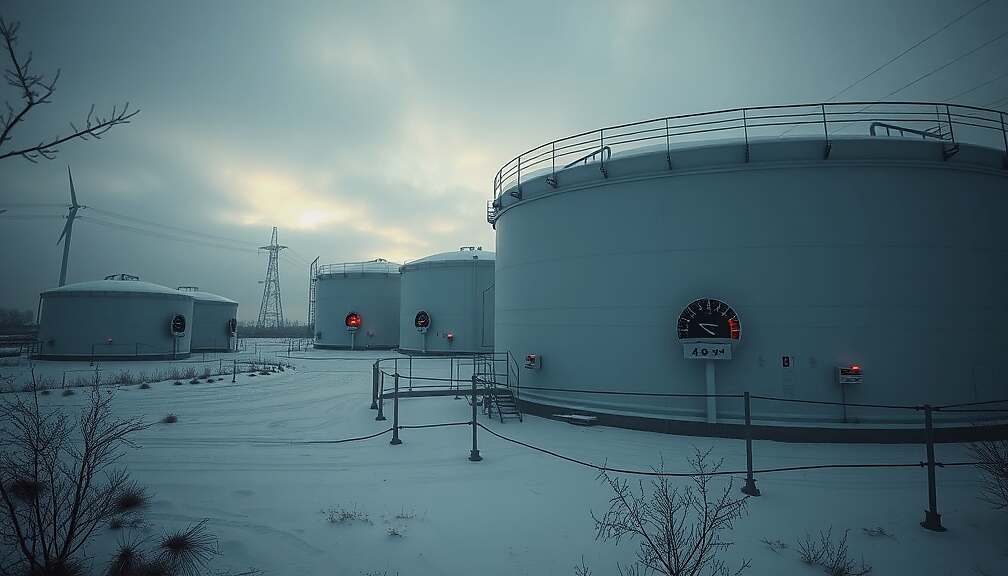
Energy economist Claudia Kemfert of the German Institute for Economic Research (DIW Berlin) has called for stronger political intervention regarding the current low levels of gas storage in Germany. She argues that the state must take proactive measures by making storage capacity targets legally binding, ensuring that booked capacity is actually filled, and building up a strategic reserve.
Kemfert cautions that relying solely on short-term purchases of LNG on the global market during the harsh winter months is both risky and costly. From a long-term perspective, she maintains that the best protection lies in significantly reducing gas consumption through improved efficiency, the adoption of renewable energy, and the ongoing transition to heat-efficient systems.
As the primary reason for the low storage levels, Kemfert points to a lack of economic incentives. She observed that gas supplied for short-term use is sometimes more expensive than gas reserved for the upcoming winter, meaning the current summer-winter business model is failing. Additionally, she cites a political problem: the current fill-level targets lack sufficient enforceability and are hardly sanctioned.
While she does not forecast an immediate scarcity, Kemfert notes that the risk increases significantly with a cold winter, unexpected supply failures, or further rises in LNG prices. Low storage translates directly to fewer safety buffers and greater price volatility. These impacts could reach consumers even before a true shortage occurs, as the mere expectation of scarcity can drive up wholesale prices, which then filter down as increased gas and heating costs.
The most unfavorable scenario, Kemfert describes, involves a confluence of pressures: a severe cold spell intersecting with low reserve levels, high global market prices, and additional supply interruptions. In such a situation, gas prices could soar, placing energy-intensive companies under severe cost pressure, though a genuine lack of supply remains the extreme outcome.
The Association of Municipal Utility Companies (VKU) has pointed to the responsibility of the Federal Government. Ingbert Liebing, the VKU’s CEO, stated that it is the federal government’s duty to continuously and comprehensively evaluate all international and economic developments relevant to the gas supply of Germany and Europe. He agreed that the Federal Ministry for Economic Affairs is correct in emphasizing the need to prepare for all conceivable scenarios in a timely manner.
Regarding their customers, Liebing suggested that the situation is not yet overly critical. Most local utilities do not participate in the international gas trade; rather, they source gas via wholesale markets. Generally, utilities have secured their gas needs for the coming winter in anticipation, which is beneficial for consumers.
Currently, German gas storage facilities are significantly less full than in previous years. The Federal Ministry for Economic Affairs targets a fill level of 80 percent by November 1st. Although the government does not anticipate a shortage, it stresses that supply is not dependent solely on storage but also on pipeline imports, LNG deliveries, and available infrastructure.
However, VKU chief Liebing also noted that even if storage levels were higher, this would not alter the fact that Germany remains reliant on gas imports in the long run. Consequently, the country’s vulnerability to price shocks originating from external gas market dynamics persists.