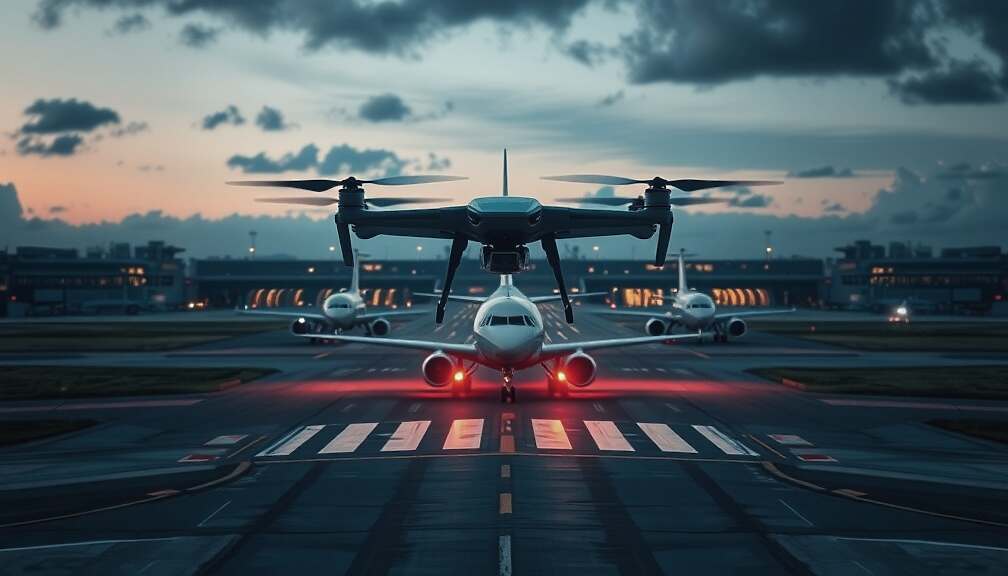
Lars Redeligx, president of the German Association of Aviation Industries (BDL), is calling for an acceleration in the implementation of drone protection across German airports. According to Redeligx, who spoke to the “Frankfurter Allgemeine Zeitung”, recent incidents in Leipzig have underscored that the threat landscape is significantly different today compared to just a few years ago. He stressed that this is both a critical safety and an economic issue.
He cited severe financial damages resulting from drone-related operational disruptions in 2025, amounting to 60 million euros in direct losses, with subsequent costs totaling 160 million euros. Consequently, he urged government ministers from both the federal and state levels to swiftly equip eight critical infrastructure airports with drone protection. Redeligx, who has been the BDL president since July 1st and also manages Düsseldorf Airport, insisted that the pace of decision-making regarding the introduction and continued development of these systems must be maintained. He expects all government agencies to conclude tenders and put systems into operation as quickly as possible.
Looking further ahead, Redeligx emphasized that drone protection efforts cannot be confined solely to the initial list of selected airports, including Frankfurt, Munich, Berlin, Düsseldorf, Hamburg, Stuttgart, Leipzig, and Cologne. He added that risk assessment ultimately should not depend only on passenger volumes or flight movements, pointing out the crucial role played by regional airports, such as their function as diversion fields for the Bundeswehr.
In addition to safety concerns, Redeligx reinforced demands for financial relief. While acknowledging the recent reduction of the aviation tax by 2.50 euros per passenger for European flights starting July 1st, he demanded a greater financial relief package of 15 euros per passenger, suggesting a complete removal of the aviation tax. This, he argued, would bring Germany back in line with the average levy across Europe.
Currently, Germany faces a cost disadvantage of 2,000 euros per flight. This disparity has led companies in the point-to-point market, such as Ryanair, EasyJet, and Wizzair, to station their aircraft in other countries. Since 2019, these low-cost airlines have withdrawn around 60 aircraft, impacting more than 10,000 jobs and losing four billion euros in value creation.