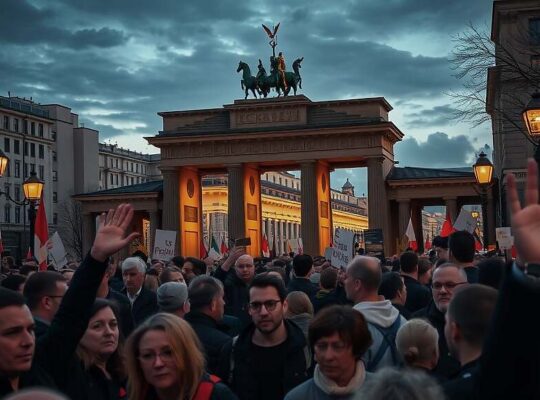
The parties-the Berlin Left, the Greens, and the SPD-recently presented an agreement outlining the basis for exploratory discussions, focusing on several key areas. The eight-point outline of the tripartite document centers on enhancing the protection and diversity of Jewish life, commemorating the Holocaust, upholding Israel’s right to exist, and combating antisemitism. Furthermore, the three parties reached an agreement concerning organized crime.
The signatories emphasized a collective responsibility to ensure a city where all residents can live safely and openly express their faith and identity. The Left, the Greens, and the SPD stated that, given their history, they bear a particular duty to protect Jewish life in Germany, committing themselves to strengthening community cohesion while promoting peace and understanding. They assert that Berlin requires a cohesive political vision, pledging to support a city where violence and terrorism are neither glorified nor normalized, where Israel’s right to existence is never questioned, and where all forms of antisemitism have no place. They guarantee this responsibility within both the House of Representatives and the Senate.
A core commitment is Berlin taking responsibility for the persecution, disenfranchisement, and murder of six million European Jews during the Shoah. The agreement promises to keep this memory alive by making the life histories of Jewish Berliners visible in memorials, educational institutions, and neighborhoods, preserving them for future generations.
Jewish communities must be able to live their religion, language, and affiliation safely, visibly, and autonomously in Berlin. The parties commit to reinforcing and protecting Jewish institutions, promoting Jewish communities, cultural activities, science, and religious practice. Essential spaces, including Jewish centers, schools, kindergartens, cultural hubs, and meeting places, will receive reliable support. Furthermore, Jewish sites and festivals will be visibly integrated into daily life and the public urban space, with all public institutions accommodating Jewish holidays and events.
Jewish individuals must be able to move through the public sphere in Berlin as naturally as anyone else. The parties oppose any climate that marginalizes people based on their actual or perceived political stance or origin. They deem unacceptable any entry bans, signs, or slogans-such as “No Zionists welcome”-at bars, clubs, or other public venues, noting these stigmatize individuals as unwanted, generate intimidation, and contribute to societal division. They also plan to strengthen international exchanges and support for Jewish and Israeli students and creatives, continuing existing scientific cooperation between Berlin and Israeli universities and research centers.
These parties strongly oppose violence, hate speech, conspiracy theories, and the denial or relativization of the Shoah. They explicitly define “Israel-related antisemitism” and reject general, indiscriminate calls for boycotts or sanctions against Israel, Israeli institutions, or individuals based solely on nationality or origin, citing examples like the BDS campaign.
Regarding public safety, they pledge to strengthen the police and the Federal Constitutional Protection Agency in their mandate to safeguard Jewish life in Berlin. These agencies will receive the necessary resources and expertise to detect and combat antisemitic crimes and threats early on. The physical protection of Jewish institutions and communities will be ensured reliably and permanently at a high level, with existing protective measures continuously reviewed and enhanced according to the assessed threat level, both in terms of personnel, technology, and infrastructure.
The exploratory partners consider Israel’s right to existence “non-negotiable.” They unequivocally condemn the massacres carried out by Hamas and other terrorist groups on October 7, 2023. They acknowledge that fear persists among people in Israel and their relatives in Berlin. However, they maintain that legitimate criticism of Israeli government actions towards the Palestinian population does not justify antisemitic actions.
The agreement advocates for a two-state solution that allows for both Israeli security and the self-determination of the Palestinian people. They are clear about identifying violations of international law and human rights, recognizing the suffering, distress, and destruction faced by the Palestinian civilian population in Gaza and the West Bank. They note that fear for relatives and polarized debates are also shaping civic life in Berlin.
To achieve these goals, they aim to reinforce prevention, education, counseling, documentation, and prosecution. They commit to perpetually supporting Jewish self-organizations and community projects. Antisemitism prevention will be strengthened in schools, teacher training, and youth programs. Berlin will permanently fund memorials and remembrance projects. They plan to expand counseling, awareness, and reporting structures so that victims receive support, antisemitic incidents become visible, and they can be effectively addressed. Furthermore, protective concepts will be established at all Berlin universities and counseling will be provided for Jewish students.
These core principles are supported by the participating parties and factions. They have created a mechanism to address violations; should any fundamental principle be breached, the relevant faction will follow its own disciplinary procedures, which include potential expulsion of members. The offended faction will transparently communicate its decision to its coalition partners, who will then address the consequences autonomously. Antisemitic incidents within the coalition factions will be handled jointly.
The exploring parties conclude by affirming that “Berlin is a city of diversity,” a place shaped by people of varied origins, religions, cultures, and ways of life. Jewish, Muslim, and Palestinian lives are an intrinsic part of Berlin. They aim to expand the Berlin Constitution, modeled after Brandenburg’s constitution, to include protection against antisemitism, anti-Gypsyism, racism, and other forms of group-based hatred.
Finally, concerning organized crime, the agreement calls for a city characterized by safety and a strong democratic rule of law. This involves maintaining a distinct distance from individuals and groups associated with organized crime. Even proactively contacting or responding to certain individuals would constitute a serious breach of these shared principles.