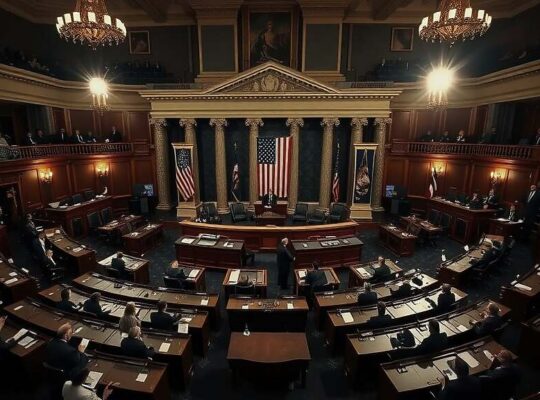
In the US midterm elections, Democrats have taken control of the Senate, alongside their grasp on the House of Representatives. News outlets such as CNN and Fox News predict that Democrats secured at least 51 seats in the second chamber of Congress.
To secure these pivotal majorities, the Democrats successfully campaigned in traditionally Republican strongholds, winning races that had not gone their way for decades. Notable victories include the Senate seat in South Carolina, which Trump had previously won by a margin of 18 points in 2024. Furthermore, Democrats achieved successes even in Texas-where a Democrat had not won since 1994-and in Kansas, which had not elected a Democratic senator since 1932.
Previously, Republicans maintained control of the Senate with a 53 to 47 seat majority. Thus, the Democrats required a net gain of four seats to achieve the majority. A Senate split exactly 50-50 historically would have afforded the deciding vote to Vice President JD Vance.
Starting in January, the Democratic majority in Congress is expected to have a significant impact on President Donald Trump and his administration. The Democrats now possess the power to block Trump’s judicial and cabinet appointments, initiate investigations, issue subpoenas, and obstruct the majority of the President’s proposed legislation. Senator Chuck Schumer, the long-standing Democratic leader in the Senate, is anticipated to take over the role previously held by Republican Senator John Thune as the majority leader.
Trump himself has already deflected blame for the Republicans’ loss in the midterm elections. On his platform, Truth Social, Trump wrote: “I was not on the ballot-and if I had been, we would have won with an landslide victory.”
Before the election, the President had attempted to improve Republicans’ chances by redesigning district boundaries (gerrymandering) in several states. He also promised $5,000 to every adult American if the Republicans secured both houses of Congress, a venture estimated to cost around $1.25 trillion.
The 2026 Midterm Elections are viewed as a crucial performance review of Trump’s second presidency, coming at a time when many American voters have expressed dissatisfaction, particularly regarding rising energy prices.