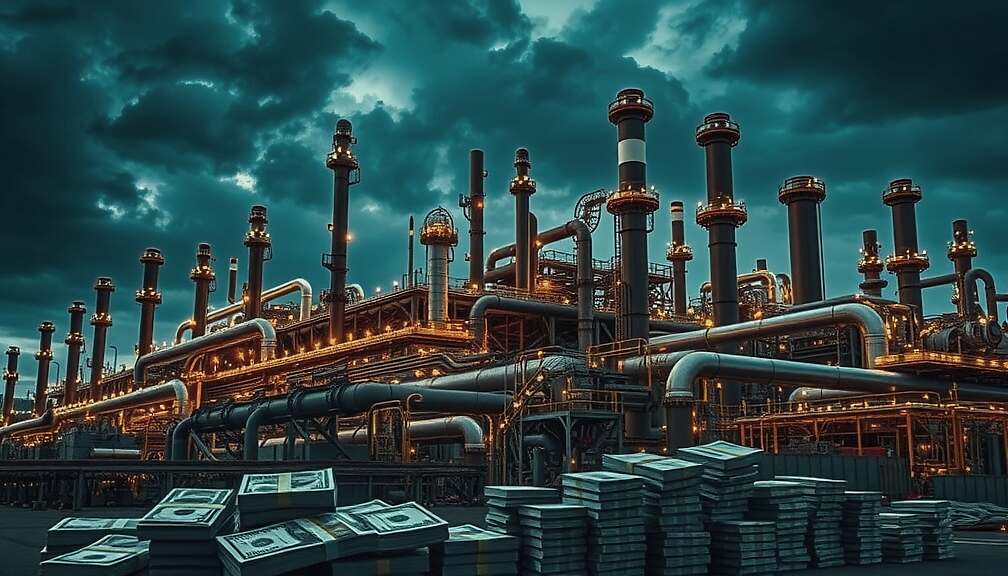
Despite the European Commission’s rejection, Austria is continuing to advocate for a European windfall tax on oil conglomerates, believing that an agreement is still possible. The spokesman for Austria’s Finance Minister, Markus Marterbauer (SPÖ), told the “Neue Osnabrücker Zeitung” that Austria remains fully committed to the initiative and finds the current demands supported. He expressed his optimism that nothing has been decided definitively on the matter.
His motivation stems from the continued and palpable impact of the war, particularly in the rising prices of oil and gas, and the current lack of an end to the conflict. The spokesman, who is an economist himself, criticized the European Commission’s current stance regarding the demand for companies to contribute funds derived from unforeseen crisis profits.
This push for a European tax was initiated back in April by the finance ministers of Germany, Austria, Italy, Portugal, and Spain. While Brussels rejected the proposal, it suggested that member states could implement such measures nationally.
Germany’s Federal Finance Minister, Lars Klingbeil (SPD), remains firm on the plan. A ministry spokesman noted that Klingbeil has repeatedly stressed that energy conglomerates should not profit excessively during times of crisis and that these over-profits must be channeled back to consumers. Consequently, the German government is continuing to explore all options to recoup excessive profits, including both instruments of competition law and a European windfall tax mechanism.
Support for this measure comes from Marcel Fratzscher, president of the German Institute for Economic Research (DIW). Fratzscher advised the German government that it should seek a joint European solution rather than proceeding unilaterally. Nevertheless, he cautioned that such a move is only realistic through enhanced cooperation among willing member states, as unanimous agreement is improbable. According to Fratzscher, any such tax would need to satisfy three criteria: it must be precisely targeted at crisis-related profits and time-limited to avoid harming investment incentives; secondly, it must be earmarked for supporting low-income households; and finally, it should be dedicated to renewable energy development.
However, Moritz Schularick, president of the Kiel Institute for the World Economy (IfW), voiced criticism. While acknowledging the appeal of a windfall tax, he stated that it is difficult to define economically and even harder to enforce legally. If the goal is to alleviate citizen burdens, Schularick suggested a broad measure independent of oil consumption-such as an energy price flat rate like the one implemented in 2022, or a reduction in the electricity tax. He stressed that the most crucial long-term priority is reducing dependency on raw materials sourced from geopolitically volatile regions.