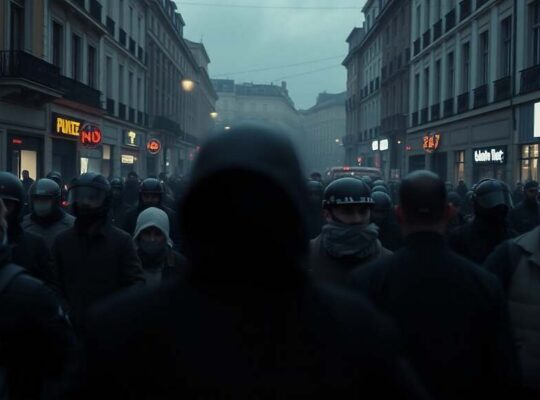
Holger Münch, President of the Federal Criminal Police Office (BKA), has warned about a fundamental shift in organized crime in Germany. Speaking to the “Welt am Sonntag”, he noted that criminals, particularly in Berlin, are younger, more aggressive, and adopt a more open and confrontational approach compared to previous generations.
Münch characterizes this emerging trend as a “Generation Z mafia,” particularly observing Turkish-dominated organized groups in Berlin. These younger perpetrators are not only more aggressive but also increasingly use social media to stage their activities. This public display is employed to intimidate rivals and bolster their reputation within the criminal underworld. Whereas discretion was historically a hallmark of organized crime, Münch reports seeing the opposite tendency among these newer offenders.
He identifies this as part of a broader transformation, describing a shift toward “Crime as a Service,” where criminal activities are outsourced. Crime groups are becoming specialized, operating like a professional workforce. Individuals now handle specific tasks-logistics, money laundering, or violence-and digital communication makes this process “very easy” today.
A particularly worrying development is the recruitment of young people into serious criminal offenses. These young individuals often fail to realize the severity of the consequences of their actions, allowing them to be exploited for extremely grave crimes in exchange for comparatively small amounts of money. Münch confirmed that this phenomenon has already reached Germany, citing cases where offenders recruited from the Netherlands participated in serious crimes here. He emphasized that the BKA is treating this development with the utmost seriousness.
Regarding the rising number of firearms, Münch explained that over recent years, sharps are being observed entering Europe, mainly originating from Turkey. These weapons often involve converted, former distress signals or are deceptively realistic replicas. The BKA is currently investigating this trend intensively, noting that the smuggling methods primarily take place via land routes into Germany.
Finally, the President of the Federal Criminal Police Office also expressed concern over the actions of foreign actors. He stated that the threat landscape has changed “very distinctly.” Since the beginning of the Russian invasion of Ukraine, there has been a significant spike in cases suspected of espionage. The BKA registered 20 such suspected cases in 2022, but this number soared to 474 in 2025. This dramatic increase reflects the significant change in the security situation since the Ukraine conflict began, which is partly attributable to increased vigilance and the scrutiny of indicators suggesting foreign state control.