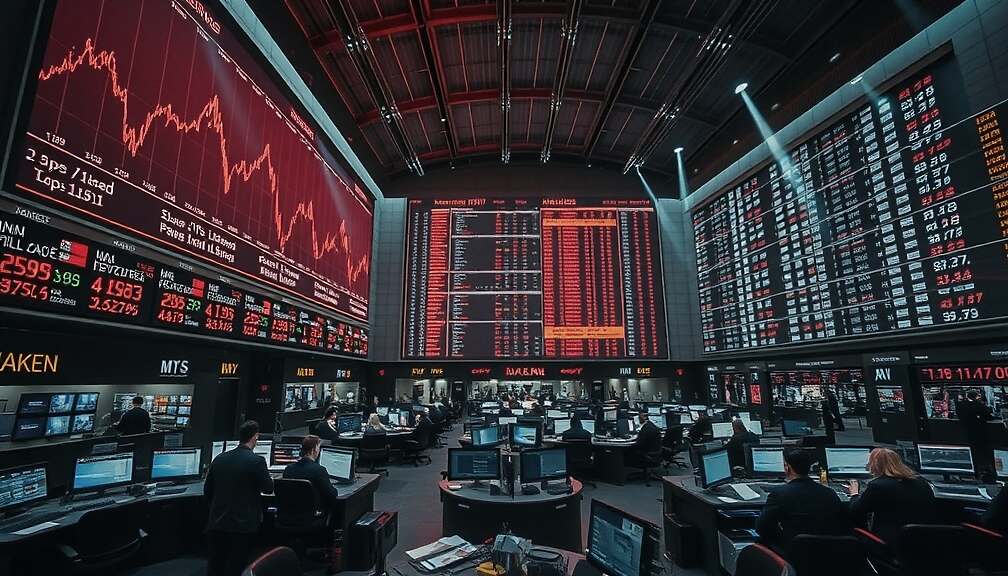
The DAX started its session on Friday morning negatively. By 9:30 AM, the leading index had dropped to approximately 25,225 points, reflecting a 0.6% decrease from the previous day’s closing level. Andreas Lipkow, Chief Market Analyst at CMC Markets, pointed out that investors are growing wary due to the high valuations within the US technology sector. The focus has shifted away from the fundamental growth prospects of artificial intelligence to the crucial question of whether the multi-billion dollar investments by hyperscalers into data centers and semiconductors can ever successfully convert into commensurately high profits.
Further headwinds are being provided by persistently high energy prices and mounting inflation fears. Although a major price shock has been averted, creeping increases in prices are starting to affect a growing number of consumers. Furthermore, the Japanese consumer price index, which saw a 2.1% rise, exceeded both expectations and the Bank of Japan’s inflation target. This development spurred selling pressure in Asian markets, particularly in Japan, South Korea, and China. The combination of rising cost of living and declining risk appetite is increasingly posing a problem for international stock markets.
Europe currently faces a lack of compelling arguments to justify new stock purchases. The inconsistent corporate earnings season reflects that many companies are grappling with challenging economic conditions. Meanwhile, investors’ willingness to justify high valuations solely on optimistic future forecasts is waning. Stock markets now require more than just positive news; they need concrete proof of sustainable growth and a reduction in the most significant risk factors. A potential impetus for markets could come from the upcoming Purchasing Managers’ Index for Europe and the United States, which will reveal whether companies can maintain sufficient economic momentum despite rising costs and softening consumer confidence. It remains hoped that at least individual sectors possess enough resilience to mitigate the weakening in private consumption.
Lipkow concluded that meaningful market improvement would require far stronger impulses, perhaps de-escalation in the Middle East leading to lower energy prices, or exceptionally convincing corporate earnings.
Regarding broader financial movements, the European common currency was slightly weaker on Friday morning, trading at 1 Euro to 1.1201 US dollars, meaning the dollar was exchangeable for 0.8928 Euro. The gold price saw a slight dip, with a fine ounce trading at $4,015 this morning (-0.1%), equivalent to €115.24 per gram. By contrast, the oil price rose significantly: a barrel of Brent crude cost roughly $114.40 USD around 9 AM German time, marking a 1.1% increase from the previous day’s close.