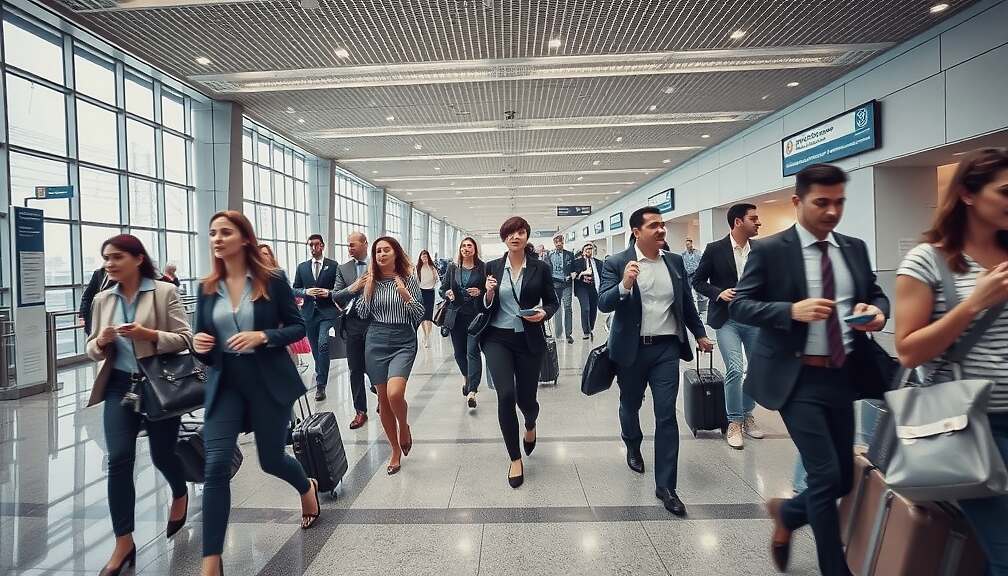
Last year, employees of German companies traveled for business 116.1 million times, representing an increase of almost eight percent compared to the previous year. This figure is nearly as high as in 2023, according to a cross-industry survey of nearly 800 companies conducted by the German Travel Management Association, as reported by Spiegel. The authors concluded that in times of crisis, personal presence remains indispensable, even serving as a survival strategy. Trust is built through face-to-face interaction, suggesting that video conferencing is not sufficient on its own.
Surprisingly, the sector driving this travel surge is not the major corporations, such as Volkswagen or SAP, but rather the small and medium-sized enterprises (SMEs). Companies with between ten and 500 employees account for more than three-quarters of all business trips. Their travel activity increased by 5.6 percent, which is five times faster than that of large corporations. The likely reason is that SMEs lack extensive departments capable of analyzing markets remotely; if a client is at risk of leaving, the managing director often has to visit them in person.
At the same time, SMEs face the highest cost pressures. They are responding by taking shorter trips and booking earlier, often in more budget-friendly travel classes. Thirty-four percent of all trips taken by employees of SMEs last a maximum of one day. Consequently, the average cost per trip across all company sizes has decreased to 418 euros, a drop of 4.8 percent year-on-year.
The mode of transport presents the largest area for saving costs. Rail has replaced air travel for domestic journeys, with 52 percent of intra-German trips now taken by train (up from 44 percent in 2024). Domestic flights play a smaller role, possibly due to a thinning of services. Only 13 percent of business travelers within Germany use airplanes, compared to half so much the previous year. This shift is likely driven by cost calculations: taking the train saves the time and expense of traveling to and waiting at the airport. Furthermore, it allows employees the opportunity to work during the journey itself.
This boom does not appear to be slowing down. Sixty-two percent of the surveyed companies anticipate even more business travel by 2026, while only four percent expect a decrease. Furthermore, in 2024, hardly any company sent significant parts of its workforce on trips. Currently, almost half are doing so, indicating that the business trip is no longer a luxury reserved for senior management but has become a routine part of professional life.