According to the Federal Statistical Office (Destatis), the German government significantly increased its investments last year. Gross state investments totaled €147.5 billion in 2025, marking a 12.3% increase, or €16.2 billion more, than in 2024. This represents the highest increase in state investments since 2000.
While there was a similar, slightly higher rise in 1999 due to statistical effects related to the rail reform and the spinoffs of German railway subsidiaries, the sharp increase recorded in 2025 was primarily driven by a strong rise in state equipment investments, which includes defense goods.
Even prior to 2025, gross investments (in constant prices) had been growing: they rose by 9.3% compared to the previous year in 2024, 4.2% in 2023, and 9.0% in 2022. The trend slowed slightly in the first quarter of 2026, when gross investments increased by just 3.2% compared to the prior year’s quarter.
The rise wasn’t just nominal; gross investments also represent a larger proportion of total state expenditure. In 2025, they constituted 6.5% of total state spending, up from 6.1% in 2024 and 5.9% in 2023. This means that over the last two years, the growth in gross state investments has been faster than the growth in total state spending. In the first quarter of 2026, this proportion stood at 5.0%.
Examining the components of gross state capital investment in 2025, the overall surge was largely due to state equipment investments jumping by 47.7% compared to 2024. This substantial growth is linked to increased spending on military weapon systems and other procurements by the Bundeswehr. For comparison, state equipment investments had grown by 7.6% in 2024 over the previous year.
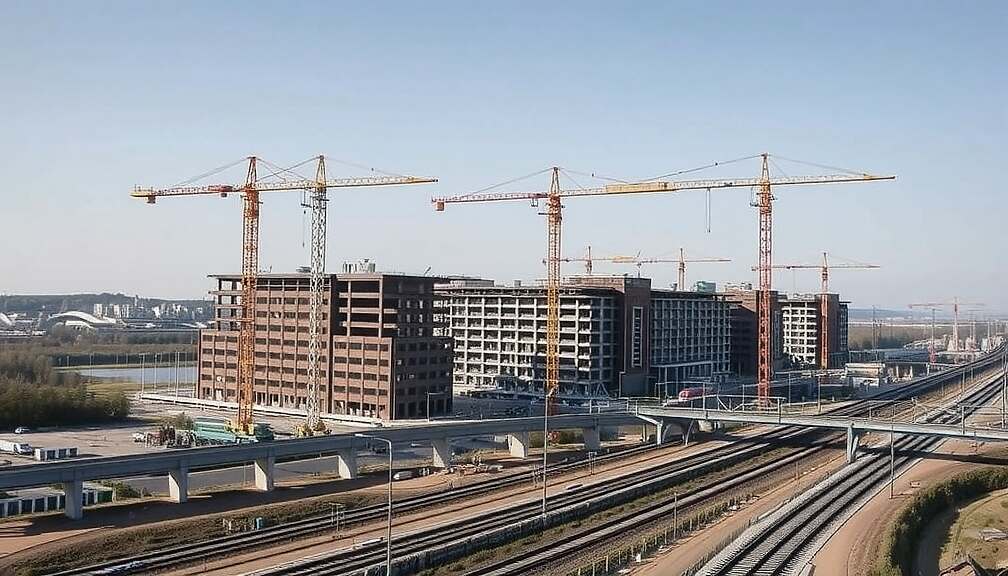
Conversely, state construction investments grew much more slowly at 2.0% compared to 2024. This is a sharp drop from 10.2% in 2024, 8.9% in 2023, and 9.9% in 2022. However, it should be noted that construction prices had also risen sharply between 2022 and 2024. Investments in other assets (principally focusing on research and development and software) grew by 5.2% in 2025, following increases of 6.7% (2024) and 1.0% (2023).
In the first quarter of 2026, equipment investments continued to rise sharply (+10.7%), and other assets increased by 3.8%. In contrast, state construction investments fell by 1.5%, attributed to unusually cold weather in January and February, which slowed construction progress.
In 2025, state gross capital investments accounted for 16.3% of Germany’s total gross capital investments, which amounted to €907.8 billion. The state played the most significant proportional role in construction investments, at 17.2%. For other assets, the state share was 16.5%, and for equipment, it was 14.7%.
Measuring against GDP, the share of gross state investments in Germany in 2025 was 3.3%. Despite this clear increase, Germany remains below both the Eurozone average (EA20) of 3.7% and the European Union (EU) average of 3.9%. Other countries saw higher ratios; for example, the Netherlands recorded 3.5%, Italy 3.8%, Austria 3.9%, France 4.5%, and Poland 5.4%. Iceland led the 27 EU member states with an investment ratio of 7.6% of GDP.