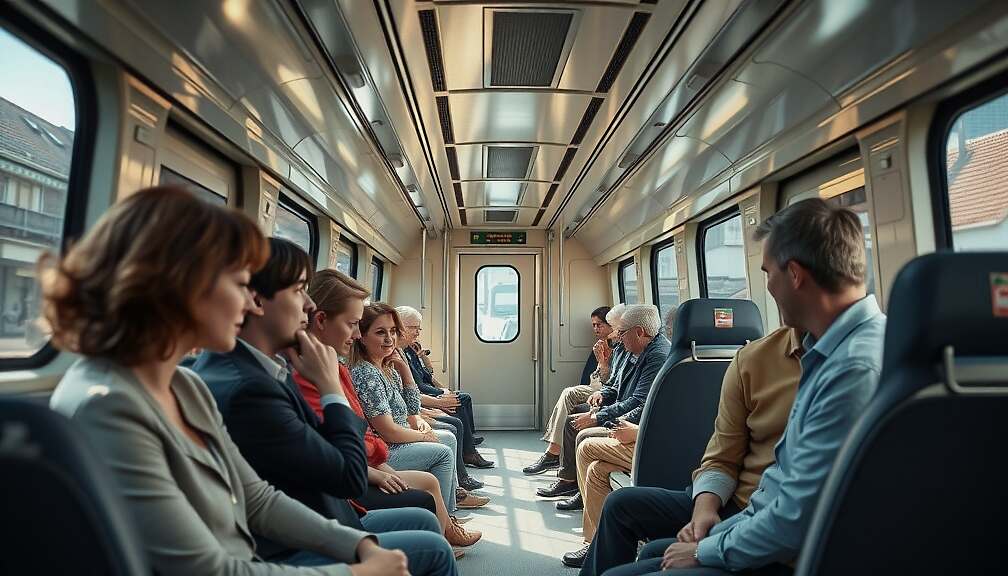
Federal Transport Minister Steffen Bilger (CDU) has promised rail passengers a noticeable improvement within three years, stating to ARD, “I want to achieve this palpable improvement.” With this pledge, Bilger is increasing pressure on Deutsche Bahn.
Bilger reiterated the government’s commitment to bringing infrastructure back up to standard, suggesting that passengers should expect at least noticeable improvements by 2029. These improvements include meeting a timeliness goal of 70 percent in long-distance travel. Given that the service recently operated at just over 50 percent punctuality, the minister acknowledged that this goal is highly ambitious, but emphasized that no complacency should set in. Beyond punctuality, Bilger noted that passenger satisfaction hinges on safety, cleanliness, and improved customer communication.
The minister also announced a new construction concept for the railway. He expressed dissatisfaction with the current method of corridor renovations and the complete closure of crucial tracks. While these segments are intended to be usable without major disruption once construction is complete, they have frequently failed to meet this promise. For example, on the Hamburg-Berlin section, which was recently renovated, punctuality dropped to just 25 percent afterward. Bilger acknowledged that the current concept had not worked and stated that the government is in intensive dialogue with the railway to develop a replacement. He intends to propose a new concept soon. Although corridor renovations will continue, he stressed the need to ensure that the completed sections function reliably. Meanwhile, the closure of the Berlin-Hanover line, which is expected to last 14 months, has begun.
The government is currently negotiating a service agreement with Deutsche Bahn. This agreement addresses the allocation of funds over the next five years, totaling a substantial billion-Euro package-over €80 billion. This represents double the funding amount of the previous five-year period, which the government views as crucial for ensuring a tangible improvement in infrastructure quality. Efficiency in using these funds is paramount.
In addressing climate goals and reducing transport’s carbon footprint, Bilger is focusing on e-mobility alongside improvements to the railway. The introduction of electric cars and commercial vehicles is accelerating, stating that the “uphill climb has begun.” However, Bilger indicated that state subsidies for purchasing electric vehicles may become less critical in the future. While the current subsidy program is set to run until the end of 2029, he is advocating against its renewal thereafter, arguing that electrically driven cars are already often the more economical choice than traditional combustion engine vehicles. He suggests that future funding should instead be concentrated on developing charging infrastructure.
The minister also aims to simplify the process of charging electric vehicles. Along the highway charging network, there will be a clear mandate that customers can pay using credit or debit cards at any time. This means users won’t need to be customers of the specific charging provider or possess cards from other companies. Bilger pledged to resolve this issue, adding that price transparency is also a priority, citing high charging costs as a barrier to e-mobility. The Ministry of Transport is currently exploring solutions to improve pricing visibility, such as displaying clear prices similar to fuel pumps, and ensuring that apps provide up-to-date information. He strongly emphasized that electric vehicle owners must have immediate, clear oversight of available options and their corresponding prices when traveling and needing to charge their cars.