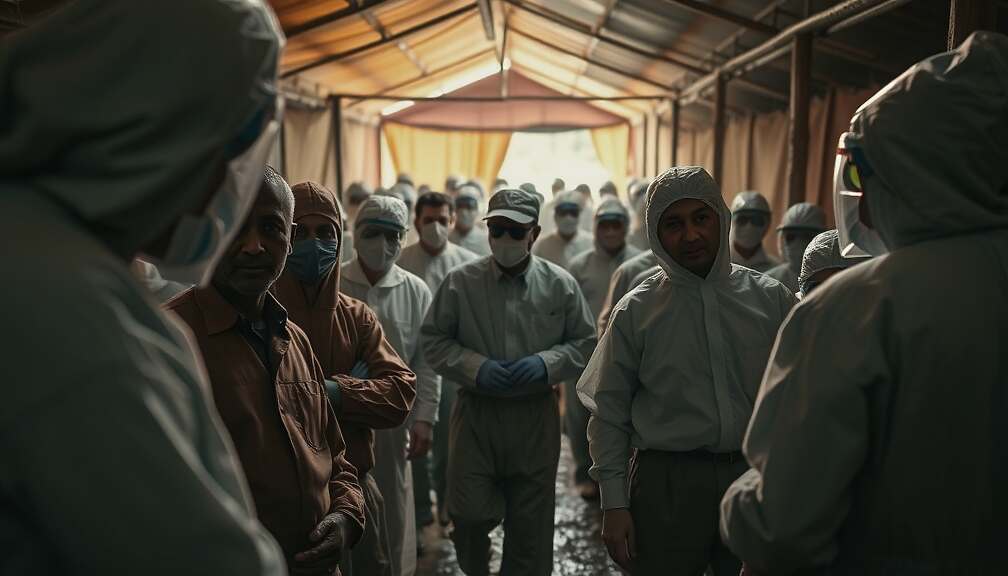
Christian Katzer, the managing director of the humanitarian organization Médecins Sans Frontières (Doctors Without Borders), has described the Ebola epidemic in eastern Congo as being of “unprecedented scale”. He stated that the situation on the ground is extremely difficult due to the ongoing civil war and the weakness of governmental structures. Furthermore, the massive cuts to international aid funding are complicating relief efforts, Katzer told the ARD’s “Interview of the Week”.
The virus in question is the Bundibugyo virus, a strain belonging to the Ebola family. Katzer noted that, unlike previous outbreaks, there are currently no approved vaccines available for this specific virus type. The situation is compounded by the lack of rapid diagnostic capabilities, which allows the virus to spread unnoticed. Many cases go undiagnosed because tests are not reliably positive, and the symptoms are non-specific, often resembling a common flu, such as fever, body aches, and chills.
The overall poor healthcare system in the region exacerbates the crisis. Katzer mentioned that for weeks, it was not realized that extremely high numbers of people were dying from the illness.
The eastern region of Congo has been marked by armed conflict for years, leading to the displacement of hundreds of thousands of people. Millions live in poverty, and medical facilities are inadequately equipped and lack essential medications. Consequently, people are reluctant to seek care. “People know that the care is bad, and that they have to pay for it. The mortality rate in hospitals is extremely high” Katzer explained.
This systemic fragility facilitates the virus’s rapid spread. Health centers themselves can become sources of infection, as medical staff become infected and unwittingly spread the virus. The heavy workload due to the high number of fatalities is also overwhelming the staff.
Katzer criticized the neglect of Ebola research in recent years, arguing that rich industrial countries bear the responsibility. Countries like the Democratic Republic of Congo are consistently the first to suffer when funding cuts are made. He argued that pharmaceutical companies show little interest in diseases from which they cannot generate large profits, stressing that states must increase their investment.
Cuts in development and humanitarian aid have profound consequences. For instance, the US Agency for International Development (USAID) has drastically reduced its assistance to Congo, dropping from approximately $1.4 billion in 2024 to just $21 million.
Although MSF is not directly impacted by state funding cuts, as the organization relies on donations, it is nonetheless experiencing the fallout. According to Katzer, prevention efforts and contact tracing-critical measures for containing the virus, as seen during the COVID-19 pandemic-are particularly affected.
Aid organizations must also combat rumors and misinformation. In affected areas of the DR Congo, claims circulated about organ harvesting or stolen blood, causing many people to fear receiving medical treatment. This drastically complicates aid work.
Furthermore, health facilities and aid workers sometimes face attacks. In Congo, for example, tents have been set on fire and stones thrown. “Disinformation is always very easy to spread” Katzer said, “but building trust requires time and personnel”.
Following the outbreak’s discovery, Médecins Sans Frontières rapidly dispatched over 100 international staff members to the area. Since the organization funds its missions through donations, it is able to react quickly. However, the work remains dangerous. Katzer warned that humanitarian workers face increasing attacks, stating, “We are seeing that humanitarian international law, which primarily protects medical staff and healthcare facilities, is being increasingly undermined”. Despite these threats, he emphasized the indispensable nature of medical care in such crisis zones, concluding that there are people in this world who cannot access healthcare, even though it is a fundamental human right.