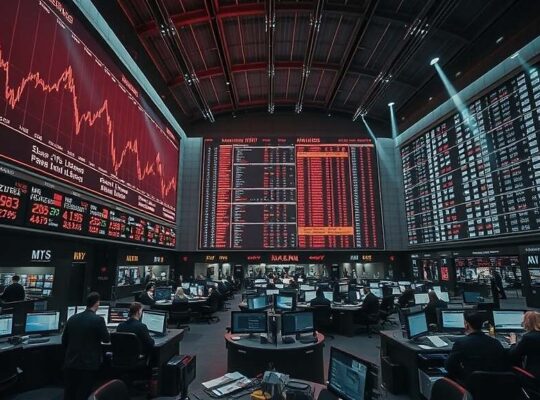
The DAX remained clearly in negative territory throughout Friday, continuing a weak start to the trading day until noon. Around 12:30 p.m., the major index was calculated at approximately 25,145 points, marking a 0.9 percent decline from the previous day’s closing level.
This subdued market performance is driven, according to Andreas Lipkow, Chief Market Analyst at CMC Markets, by recent disappointing European purchasing manager indices. “The latest European purchasing manager indices offer investors hardly any arguments for new stock purchases,” Lipkow stated. He pointed out that data fell short of expectations outside of the German services sector, with indicators in France even entering a contraction phase. This dampens hopes for a sustained economic recovery in Europe.
A major concern cited is the lack of relief in energy prices. The Brent North Sea grade is nearing the $115 per barrel mark, increasing the risk that the already weak economy could be further strained by rising production costs and renewed inflationary pressures. European stock markets are increasingly being squeezed between weaker growth and persistent price pressure.
Adding to the pressure, Lipkow noted that the technology stocks-which had previously been the driving force behind the market rallies-are losing momentum. Investors are facing a dual challenge: deteriorating economic conditions alongside diminished expectations for an enduring AI boom to support share prices. If previous winners fail to boost the market while the economy weakens, the outlook for the broader market becomes increasingly tenuous.
In financial movements, the European currency faced slight weakness on Friday afternoon; the euro traded at $1.1201, meaning the dollar was available for 0.8928 euros.
Regarding commodities, the price of gold saw a slight increase, reaching $4,025 per fine ounce in the afternoon (+0.1 percent), equivalent to 115.53 euros per gram. Conversely, the price of crude oil rose significantly. Around noon Central European Time on Friday afternoon, a barrel of Brent North Sea crude cost $114.30, which was a 1.0 percent increase over the previous trading day’s close.