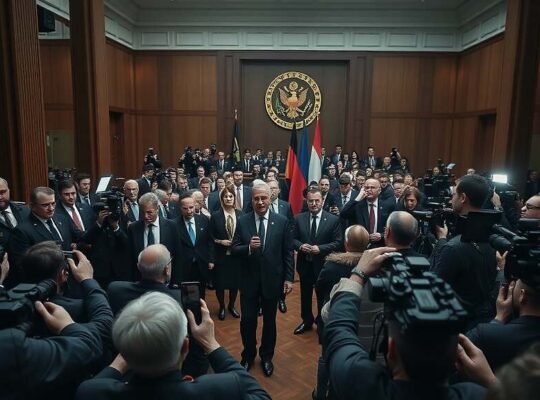
Manuela Schwesig, the Minister-President of Mecklenburg-Vorpommern, has sharply criticized the timeline set for the upcoming SPD party leadership elections, expressing regret over the decision to schedule the party convention so early in January. While acknowledging the resulting time pressure, she stated firmly that she would not let this pressure guide her actions.
Schwesig emphasized that her primary focus remains on Mecklenburg-Vorpommern. She noted that, in the weeks leading up to the election, she clearly indicated her commitment to ensuring a stable coalition in the region, insisting she would not be distracted by extraneous political debates. When asked whether this focus meant she was definitively not available to take the role of party leader, she elected to remain noncommittal.
She also launched a fierce attack on Federal Chancellor Friedrich Merz (CDU). Schwesig referred to an incident in late September at the Chancellery, during which Merz pulled her aside near a meeting with state leaders and accused her of destroying the democratic center through her campaign tactics. She recalled withdrawing from that situation at the time, telling the Chancellor that if he wished to speak with her, he should schedule a proper meeting. Schwesig stated that being “pulled aside and insulted like that is too much, and one must put a stop to it.” She added that “I think many women understand it-that they should not be treated that way by others. No woman should be treated in our country like that.”
Previously, Schwesig had advised the Chancellor to be more self-critical. She even told Merz personally that if he only achieved five percent approval in her state, he would need to engage in deep self-reflection. She stressed that pointing the finger and blaming others was insufficient.
Addressing the ongoing coalition negotiations in Berlin for the Red-Green-Red configuration, Schwesig stated she does not wish to interfere but was very clear on one point: In Mecklenburg-Vorpommern, all alliance partners understand that combating antisemitism is a critical directive that must be treated seriously. Furthermore, there must be no ambiguity regarding the fight against crime, especially organized crime. She expected the SPD to hold this clear stance across the entire country and ensure its proper implementation. Regarding the plan for the nationalization of services in Berlin, Schwesig expressed skepticism, stating, “I have question marks about that.”
Concerning the question of who should become the next Head of State, Schwesig agreed that nominating a woman is correct and that “it is time.” She believes a leader is needed who can effectively reach people and unify the country. She expressed a hope that the debate should once again feature shared values, cohesion, respect, and mutual cooperation.
When asked specifically about Ilse Aigner (CSU), Schwesig mentioned knowing her only casually. “But where I met her, I found her good, and I appreciate her,” she said. However, she noted that the right to propose candidates belongs to the Union. “We respect that.”