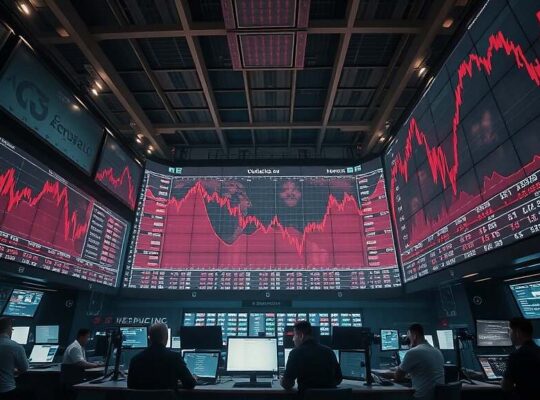
The DAX declined on Tuesday, closing cross-exchange trading with 25,402 points-a drop of 0.2 percent compared to the previous trading day. Although the index recovered much of its losses after a weak start, it failed to break significantly higher.
Andreas Lipkow, Chief Market Analyst at CMC Markets, commented that despite the DAX recovering from its intraday low of under 25,200 points, market sentiment remains tense due to geopolitical and monetary uncertainties.
Lipkow highlighted several major economic anxieties. The oil price, remaining well above $100, coupled with rising pump prices, is expected to weaken the German economy and continue pushing up the costs of various goods and services, a trend already seen in wholesale prices this morning.
Furthermore, rising bond yields are putting increasing pressure on stock prices. Lipkow noted that ten-year US bonds are persistently above the five percent mark. Similar discomforting highs in yields are being reached across the UK, Japan, and Germany, complicating matters for both consumers and governments trying to manage their budgets.
The analyst explained that this increase in interest burden is leading to a slowdown in both consumer spending and investment, creating a currently unattractive investment environment where no investor wants to be the last one holding a matchstick. He concluded that the typical volatility associated with the traditionally turbulent month of September is indeed proving its worth.
Turning to the upcoming US Federal Reserve meeting, Lipkow suggested that a 25 basis point interest rate increase is expected in Washington. The market’s expectations are likely to be met, allowing the Fed to utilize its opportunity for a moderate tightening of monetary policy. Lipkow stressed that the subsequent press conference will be crucial in indicating how much the central bankers are influenced by current price developments.
Even the AI and semiconductor stocks, which have previously been stabilizing factors in the bull market, are beginning to show signs of weakness, according to the analyst. He specified that this is currently impacting highly valued US stocks. However, he cautioned that this correction is only partially affecting DAX companies, as the fundamental structure of the German benchmark index contains insufficient technology to be significantly affected.
Market movements during the day saw Rheinmetall stocks lead the gainers, followed by Qiagen and RWE. By contrast, Zalando shares finished at the bottom of the market.
In commodity markets, the natural gas price dropped. A megawatt-hour (MWh) of gas scheduled for October landed at €80, representing a 3 percent decrease from the day before. If this price level remains stable, this implies a consumer price of at least around 13 to 15 cents per kilowatt-hour (kWh), including ancillary costs and taxes.
Conversely, the oil price surged. A barrel of North Sea Brent oil cost $108.30 on Tuesday afternoon, an increase of 2.5 percent from the previous day’s close.
On the currency front, the Euro weakened slightly on Tuesday afternoon, trading at $1.1542, while the Dollar was available for 0.8664 Euros. Gold prices also dipped, with a fine ounce trading at $4,285 in the afternoon (-0.3 percent), corresponding to a price of €119.35 per gram.