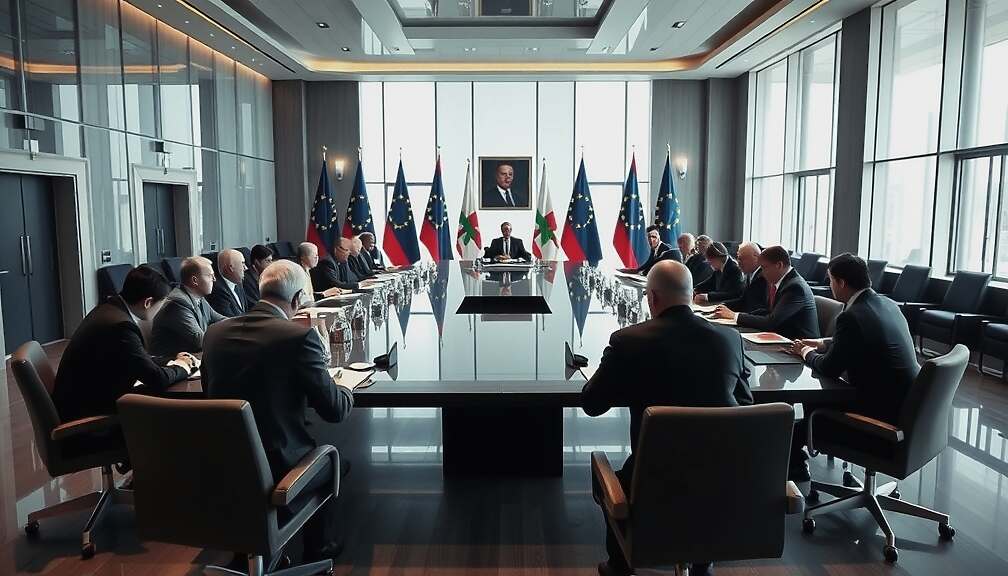
As the European Union heads of state and government gather for their meeting in Brussels, a growing consensus among many European capitals suggests that the outcome of the war between Russia and Ukraine may be determined less by battlefield tactics than by the economic strain placed upon the combatants. Discussions in Brussels on Thursday revealed a generally accepted notion that the Russian economy is increasingly being burdened by the costs of the conflict.
It is reported that approximately 40 percent of Russia’s energy infrastructure is either unusable or damaged, although it remains unclear whether this damage is primarily the result of Ukrainian strikes or if other factors are contributing. One thing is certain: Ukraine is increasingly succeeding in conducting massive attacks deep within Russia’s rear territory. These operations are not only achieving military success but also are being displayed to audiences globally, including in Brussels. Security circles in Europe widely anticipate that these strikes significantly amplify economic pressure on Moscow, even if Ukraine’s own energy infrastructure has suffered even greater destruction.
On the sidelines of the EU summit, NATO member states will also continue their coordination ahead of the defense alliance meeting in Turkey. This discussion will cover ongoing military support for Ukraine and potential scenarios for future negotiations with Russia.
There is a shared understanding, as has been the case for months, that any potential peace talks should include not only Russia and Ukraine but also Europe and the United States. However, a designated European negotiating leader has yet to be solidified. For any serious dialogue to take place, the necessary prerequisites must first be established, with the critical condition being that Europe’s security interests are not decided without European input.
Furthermore, an EU perspective for Ukraine is a recurring topic in Brussels, especially given the recent arrival of President Zelensky. A “partnership” model was recently discussed. According to internal reports circulating in Brussels, Zelensky reportedly dislikes the term “associated partnership,” stating that he has become somewhat “burned” in Kyiv by the concept, though he has yet to settle on an alternative.
The widely known “Association Agreement” between the EU and Ukraine, first signed in 2014 by EU leaders and then-Ukrainian President Poroshenko, is reportedly met with skepticism and reluctance in Kyiv. In the Netherlands, the agreement was initially rejected via a referendum. Subsequently, the Dutch government introduced an annex that excluded security guarantees, military aid for Ukraine, and any obligation by the EU to grant Ukrainians freedom of movement within the Union. Of course, the war has since largely neutralized these limitations.