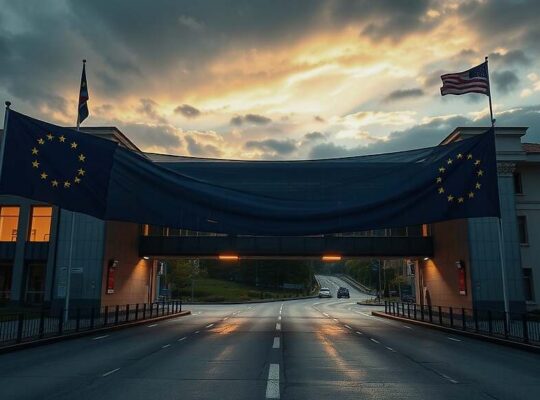
The unveiling of President Donald Trump’s new security strategy signals a fundamental shift in transatlantic relations, potentially dismantling decades of unwavering US support for Europe and posing an existential threat to the European Union, according to German CDU foreign policy expert Norbert Röttgen. Speaking at the Doha Forum, Röttgen described the move as a “second turning point” marking a break from the post-World War II era where the US consistently stood alongside European nations.
Röttgen’s critique extends beyond mere disappointment; he argues that the strategy represents a deliberate reversal of a historical partnership that has underpinned Europe’s stability and prosperity. “The transatlantic alliance, the construction of liberal democracy, the social market economy, reunification – none of this would have been possible without an American policy dedicated to a liberal Europe. It’s our political foundation. The current US administration is inverting this” he stated.
More alarmingly, Röttgen suggests the new strategy aims to actively interfere in the internal affairs of European states, aligning with ideological aims aligned with the “MAGA” movement and collaborating with elements perceived as adversaries of liberal democracy within Europe – specifically citing the AfD in Germany as a concerning example. He posits that this interventionism is intended to manipulate European political constitutions according to these external ideological dictates.
The situation presents Europe with a perilous predicament, caught between Russia’s military aggression and this perceived internal pressure from the United States. Röttgen emphasized the urgent need for Europe to assert its sovereignty, singling out the European Council’s pending decision on repurposing frozen Russian assets as a critical test. This decision, he argued, constitutes “a necessary expression of our will to assert ourselves” sending a clear message to both Moscow and Washington. Crucially, it would also provide vital funding for Ukraine, enabling its defense and facilitating a path towards a political resolution of the conflict. The future of the EU, according to Röttgen, now hinges on Europe’s ability to navigate this fraught geopolitical landscape and chart its own independent course.