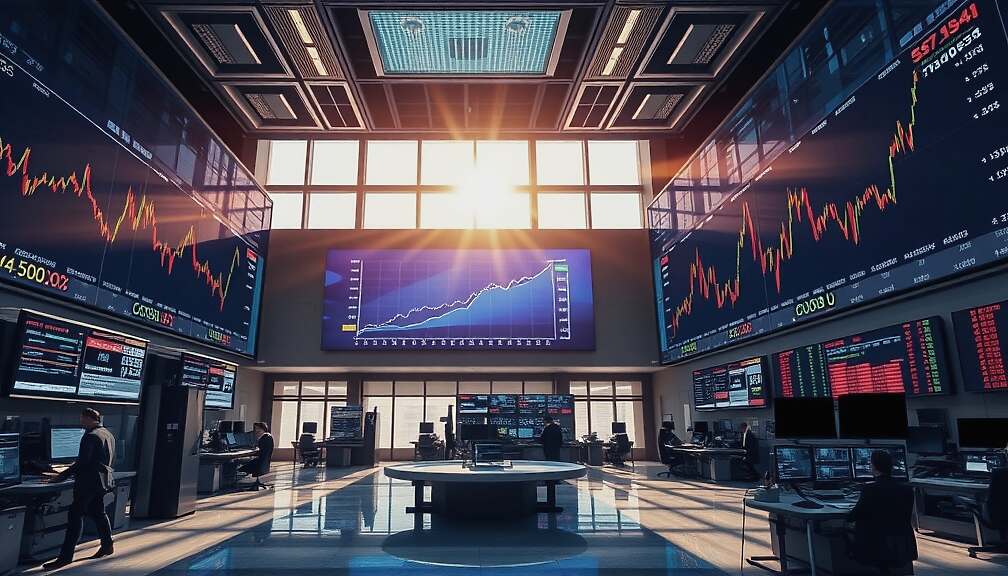
The German market opened the week with positive momentum. At 9:30 AM, the DAX index was calculated at around 24,190 points, representing a 0.3% increase from the previous day’s closing level.
Commenting on the sentiment, Jochen Stanzl, Chief Market Analyst at Consorsbank, noted that global markets experienced a “real buying frenzy” in April. However, he cautioned that the pace of stock purchases might slow down due to upcoming meetings by the US Federal Reserve and the ECB, alongside a massive influx of earnings reports. He mentioned that investors are currently betting on the conclusion of the Iran conflict, strong quarterly figures that demonstrate corporate resilience despite high energy costs, and central banks viewing inflation only as temporary-thereby refraining from raising interest rates.
Stanzl stated that the probability of these expectations being generally accurate remains high. Evidence of rapprochement between Iran and the US has increased, and most published financial statements have been better than anticipated. Crucially, clear signs pointing toward imminent rate hikes are absent, suggesting that those hoping for significantly lower entry prices must contend with the possibility of no new market sell-off.
Looking ahead, the week marks the most critical period of the earnings season for Wall Street. Approximately half of the S&P 500 companies by market capitalization, alongside five of the Magnificent Seven, are scheduled to release their financial results. Investors are hopeful that these reports will continued to indicate high investment in AI data centers, thus justifying the substantial gains seen in AI stocks recently. Experts observed that US companies, in general, are performing better than their European counterparts, and investors are hoping the US economy can weather high energy costs and supply chain issues more effectively than Europe.
While the week could become potentially volatile, particularly around Thursday when Microsoft, Alphabet, Meta, and Amazon are scheduled to announce their earnings, overall stock fluctuations have already significantly dampened. Volatility in the DAX is currently at a pre-war level, whereas the S&P 500 index shows considerably less fluctuation. This suggests that many investors are becoming willing to discount the effects of the Iran conflict. Stanzl remarked that the threat of a renewed conflict or a resurgent US attack on Iran is largely dismissed by most investors; the focus has shifted simply to when the Strait of Hormuz can reopen.
In other indices, the European currency was stronger, with one Euro costing 1.1733 US dollars, or conversely, one US dollar buying 0.8523 Euro. Meanwhile, the price of gold rose slightly, reaching $4,718 per fine ounce (a 0.2% increase), equivalent to €129.27 per gram. Oil also saw a sharp jump; a barrel of North Sea Brent crude cost $107.70 at 9 AM German time, marking a 2.3% gain compared to the previous closing bell.