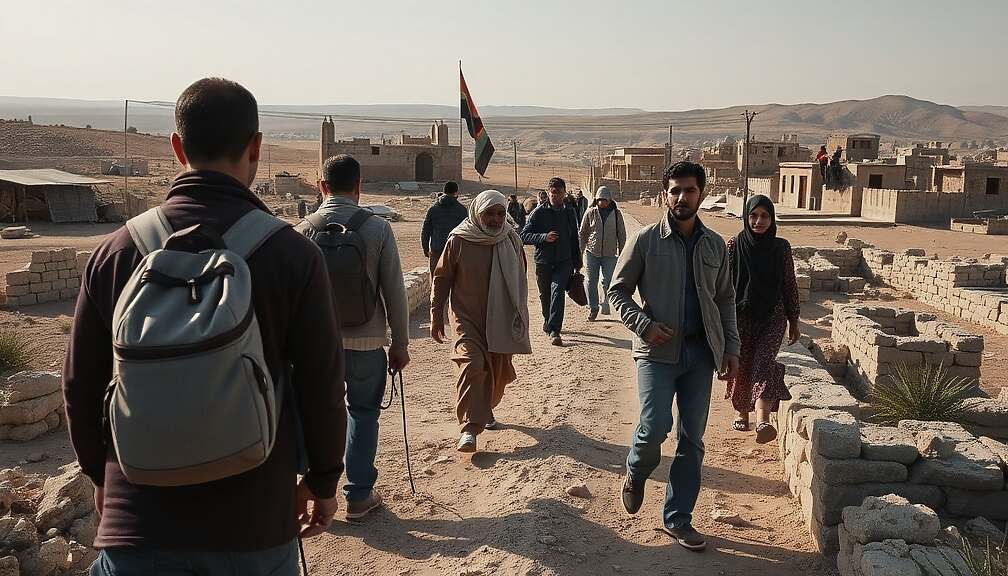
Since the end of the Syrian Civil War on December 9, 2024, at least 10,009 Syrians have returned to their home country from Germany. This figure comes from a survey conducted by the news magazine “Focus” across all 16 German federal states. Bayern saw the largest number of returns, with 2,761 individuals departing, while Hamburg recorded the fewest, with only 52 people returning. These surveyed figures significantly surpass earlier projections; according to data released in February 2026 by the Federal Office for Migration and Refugees (BAMF), only 3,678 Syrians had returned during the preceding year.
Globally, however, not many Syrians are rejoining their homes from Germany. The UN Refugee Agency (UNHCR) reports that a total of 1.63 million Syrian refugees have returned since the war’s end, primarily originating from Turkey, Lebanon, and Jordan.
Despite the increasing trend of return migration, for many Syrians holding German passports, dual citizenship is proving more popular than voluntary repatriation. For example, in North Rhine-Westphalia (NRW), 18,567 Syrians became naturalized citizens last year, while only 837 Syrian refugees left those state. In Bremen, one,224 Syrians received citizenship in 2025, compared to just 109 departures during the same period. This trend of heavy assimilation with low departure rates is evident across all other federal states as well. Indeed, Syrians have been a leading demographic among new citizens in Germany for several years; they accounted for 20 percent (65,574 individuals) of the 332,500 foreigners who gained citizenship in 2025.
The German government is actively seeking ways to encourage more voluntary returns. According to “Focus” information, the Federal Ministry of the Interior is currently examining a potential return premium amounting to 8,000 euros. Currently, Syrians receive an average of 1,000 euros for voluntarily leaving the country. Several members of the CDU/CSU parliamentary group support stronger financial incentives. Union Vice-Chair Günter Krings stated that voluntary return represents the best and most cost-effective solution for all parties involved, suggesting that consideration should be given to higher return aid.
The Syrian Civil War concluded with the fall of long-time dictator Bashar al-Assad in December 2024. His successor, transitional President Ahmed al-Scharaa, visited Chancellor Friedrich Merz (CDU) in Berlin in March 2026, during which time Merz hinted that 80 percent of Syrian refugees could return to Syria within the next three years.