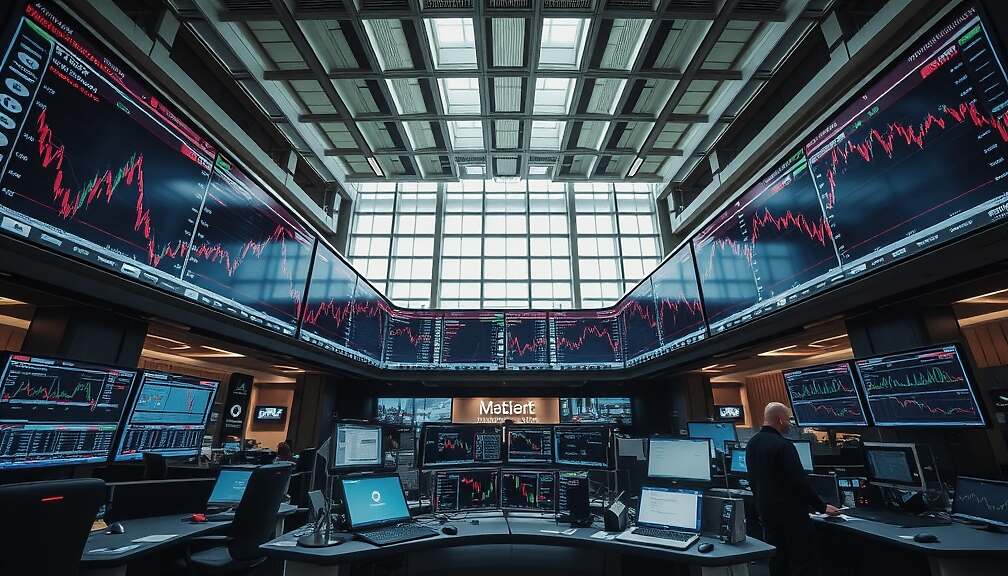
The Dax experienced a significant decline on Tuesday, closing the Xetra trading session at 25,465 points, which represented a 1.4 percent decrease compared to the previous day’s close. After starting slightly in negative territory, the index steadily expanded its losses.
Andreas Lipkow, Chief Market Analyst at CMC Markets, noted that the apprehension surrounding a potential sudden end to the rally in AI-related stocks-which had previously displayed only upward momentum on the exchange-was palpable in the market. He commented that leading stocks from recent months were faltering, leading to heightened nervousness among investors. Consequently, many investors in Frankfurt were inclined to reduce their risk exposure rather than building new positions.
Lipkow viewed the current trend in the Dax as a welcome consolidation following the recent strong rally. He emphasized that investors were not completely abandoning the market; rather, they were becoming more selective in their dealings. Overall, he described the prevailing market sentiment as “cautious,” but added that the market was no longer finding just good news sufficient.
Investor nervousness is also rising just before the start of the earnings season, according to the analyst. He explained that expectations are highly ambitious, and if there is even the slightest sign that earnings momentum is slowing, disappointment could surface, potentially bringing “heatwaves” to what was otherwise expected to be a quiet summer. Lipkow pointed to an example from the day: the Korean electronics conglomerate Samsung faced widespread selling pressure despite reporting continuously strong results, a profit growth that was nineteenfold in the past reporting period and figures few could have imagined two or three years ago.
Leading the companies on the Dax list just before the close were Beiersdorf, FMC, and SAP. Infineon and Siemens Energy finished at the bottom of the decliners’ list.
Separately, energy prices saw movement. The price of gas increased, with a megawatt-hour (MWh) expected for August reaching 47 Euros, a six percent rise from the previous day. If the price level remains stable, this implies a consumer price of at least nine to eleven cents per kilowatt-hour (kWh), including taxes and ancillary costs.
Oil prices also rose sharply relative to their baseline. A barrel of Brent crude, sourced from the North Sea, cost approximately 73.89 US dollars on Tuesday afternoon at 5 PM German time, representing a 2.6 percent increase from the previous trading day’s close.
Meanwhile, the European common currency weakened slightly during the Tuesday afternoon trading. The Euro traded at 1.1427 US dollars, meaning that the Dollar could be acquired for 0.8751 Euros.