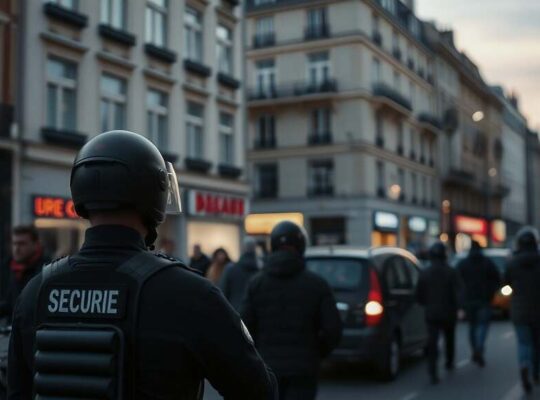
According to Stephan Kramer, President of the Thuringian State Office for the Protection of the Constitution, the most significant Islamist terror risk in Germany currently comes from individual perpetrators. Kramer informed the “Handelsblatt” that attacks are most likely to be perpetrated by single actors or small, independent groups who utilize easily obtainable means, such as vehicles, knives, or improvised weapons. While the threat posed by Islamism remains persistently high, it is not currently acute or pervasive across the nation.
Examining the alleged Islamist-motivated attack on Christopher Street Day (CSD) in Berlin, Kramer pointed to several typical risk factors. These included the perpetrator’s advanced jihadist radicalization, a previous attempt to leave the country to join the Islamic State (IS) terrorist militia, his classification as a threat/risk individual, existing experiences in detention and abroad, and his recent release from prison. However, Kramer cautioned against drawing mistaken conclusions solely based on a suspected perpetrator’s origin. He emphasized that German citizenship does not diminish the Islamic danger, nor does his Lebanese background explain it; rather, concrete evidence of radicalization is what determines the risk.
Regarding the management of high-risk individuals, Kramer articulated a fundamental dilemma. In a state governed by the rule of law, no individual can be indefinitely detained based only on a risk assessment. Even continuous observation requires considerable resources and cannot reliably prevent spontaneous attacks involving cars or knives. Therefore, Kramer advocated for earlier criminal prosecution, improved support for radicalized offenders while incarcerated, tighter supervision after release, legally sound monitoring measures, electronic ankle monitors, regular case conferences, and long-term deradicalization efforts. He concluded that “there is still room for improvement in all these areas.”
Furthermore, Kramer warned against viewing the Islamist threat as an imported problem. Many offenders were born or raised in Germany and only radicalized locally. While the ideology often originates abroad, he noted that many perpetrators become radicalized within Germany through various channels, including social media, friendship networks, local scenes, messenger groups, prison contacts, or travel abroad.