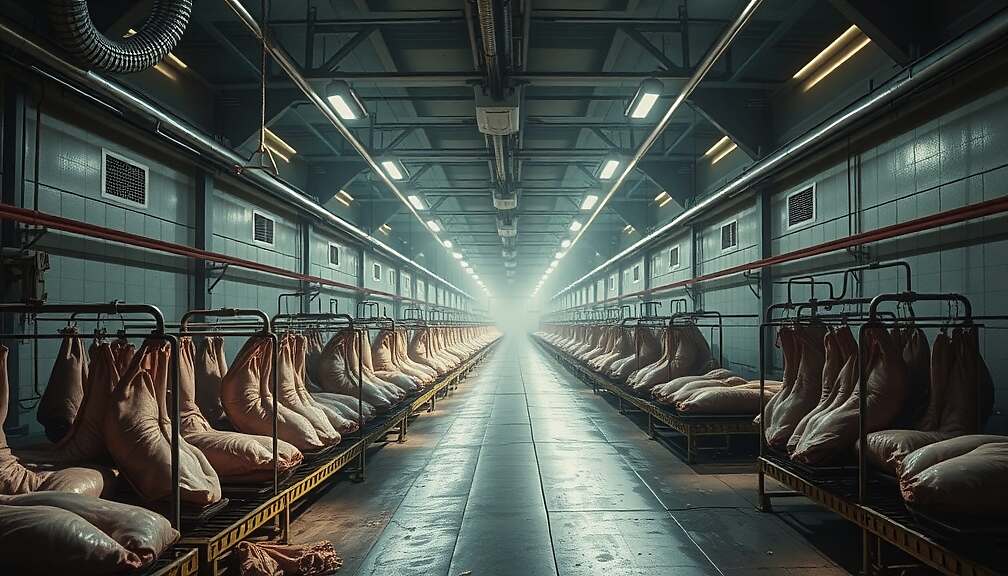
According to preliminary results released by the Federal Statistical Office (Destatis) on Friday, commercial slaughtering operations in Germany produced just under 3.4 million tons of meat during the first half of 2026. This figure represents a slight decrease of 0.7%-equivalent to 24,200 tons-compared to the same period last year. Overall, 23.9 million pigs, cattle, sheep, goats, and horses were slaughtered in the processing facilities, alongside 343.2 million chickens, turkeys, and ducks.
Pork remained stable, with 22.1 million pigs slaughtered in the first half of 2026, showing no significant change (an increase of 8,400 animals or 0.0%) compared to the previous year. Of these pigs, 98.2% were of domestic origin, totaling 21.7 million animals, and the number of imports remained unchanged at 406,000. The amount of pork produced reached 2.1 million tons, which was nearly flat year-over-year, increasing by 800 tons.
In contrast, beef production declined slightly. Output fell by 600 tons, or 0.1%, to 462,200 tons. During this period, facilities slaughtered 1.4 million cattle, which was 0.1% or 1,900 fewer than in the same period last year.
Poultry production saw a drop in the quantity of slaughtered animals. A total of 343.2 million various poultry were killed in Germany during the first half of 2026, representing a 0.8% decrease. Consequently, chicken, turkey, and duck meat production fell by 3.2%, totaling 24,900 fewer tons than the previous year.
Pork continues to hold the largest share of commercial meat production in Germany. In the first half of 2026, 63.6% of the meat produced came from slaughtered pigs. Poultry followed with 22.4%, and beef contributed 13.7%. Destatis noted that meat from sheep, goats, and horses made up only about 0.3% of the total production.