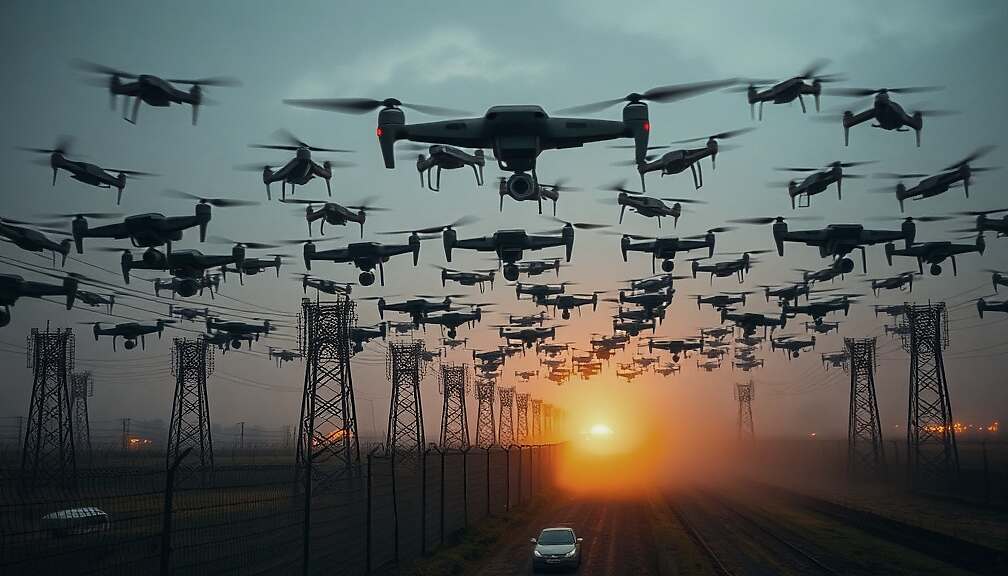
A study conducted by the International Institute for Strategic Studies (IISS) in London, in cooperation with the Hanns-Seidel-Stiftung, has concluded that Europe is not adequately prepared to handle a suspected Russian drone campaign. The institute noted that current anti-unmanned aerial vehicle defenses are inadequate for the actual threat level.
The paper cites several systemic weaknesses: detection methods are inconsistent, legal authorities are fragmented, the available response options are often disproportionate, and the process of attributing responsibility is too slow to allow for timely deterrence.
The “Study on Russia’s UAV Campaign over Europe” documents that between August 2024 and February 2026, unmanned aerial vehicles (UAVs) were observed in the airspace of twelve NATO member states, alongside Ireland. The study assesses the likelihood of Russia being responsible for this campaign as “very high.” According to the report, it is likely that vessels linked to Russia and those within the so-called “Shadow Fleet” were utilized as launch and recovery platforms for the UAVs, as part of a broader, unconventional war waged by the Kremlin against Europe.
Currently, the most ambitious joint European reaction is the European Drone Defence Initiative (EDDI), which aims to establish a comprehensive, 360-degree drone defense architecture across Europe, targeting initial operational capability by the end of 2026. However, the study highlights a critical internal flaw: in January 2026, the European Parliament determined that the EDDI lacked both the necessary doctrinal coherence and agility. Furthermore, the study emphasizes that even if the EDDI were fully operational, it could only engage the UAV once it had infiltrated European airspace, and it does not possess the mandate required to act against the vessel from which the drone was launched.
Klaus Holetschek, Chairman of the Hanns-Seidel-Stiftung, described the situation as an “alarming threat.” Although direct attribution is inherently difficult, the study leans toward the conclusion that Russia is likely behind a coordinated UAV campaign across Europe. Holetschek stated to the “Tagesspiegel” that it is deeply alarming that Europe has not been sufficiently prepared for this form of hybrid threat, noting the ongoing issues with inconsistent detection, fragmented legal powers, unsuited response capabilities, and protracted attribution times.