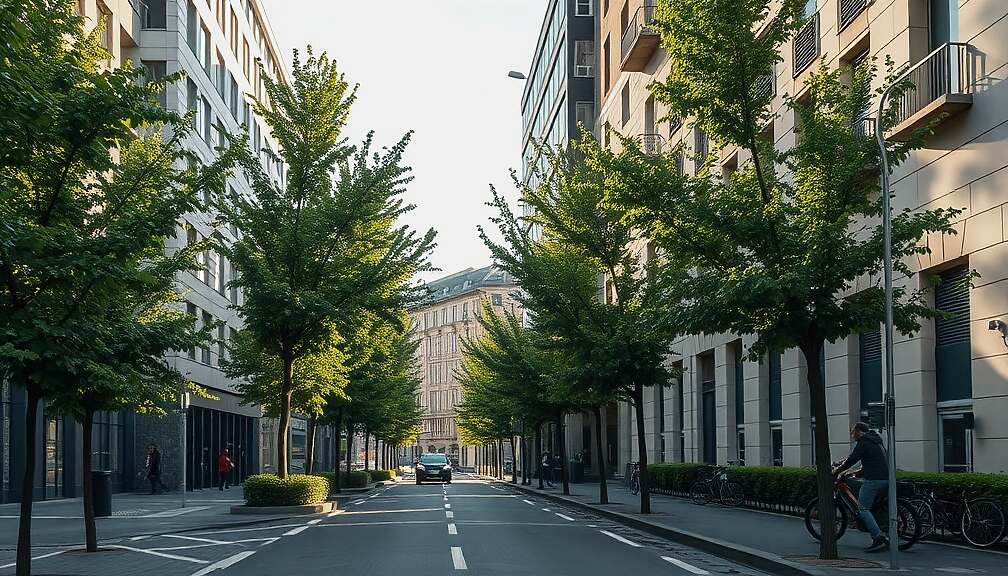
To advance measures for heat protection, the Green Party plans several initiatives, including increasing tree coverage in municipalities and cities through federal funding, introducing a new national tree law, and aiming for net-zero paving in Berlin by 2030.
According to a policy paper released by the Green Party federal executive board, the party intends to finance the planting of at least one million additional street trees across cities and towns by 2030 using federal funds. In Berlin, they support the implementation of a tree decision that aims to more than double the urban tree population to one million street trees by 2040.
Furthermore, the Greens propose establishing a new “Tree Law.” This law would require that at every construction site-whether it involves laying new water pipes, resurfacing roads, building tram tracks, or repairing sidewalks-a review be made to see if new trees can be immediately incorporated. In Berlin specifically, they plan to double the number of replacement plantings.
Their overall goal is to align local development plans consistently with heat protection. They propose using the “3-30-300 Principle” to ensure that every residential building has at least three visible large trees, that every neighborhood and village achieves a canopy cover of at least 30 percent, and that no house is more than 300 meters away from a public green space or park.
In Berlin, the objective is to reach “net-zero paving” by 2030. This means that any new impermeable surface area must be offset by de-paving elsewhere. To help mitigate heat in busy and hot locations, the party suggests that public amenities such as drinking fountains, water dispensers, misting showers, nebulization machines, sun sails, and shaded seating should be financed through a federal program. Crucially, the Greens also demand that every municipal authority establish a dedicated “Heat Team” in City Hall.
Additionally, high-risk facilities-including hospitals, elderly and care homes, schools, kindergartens, and youth centers-should receive improved heat protection through an immediate program funded by the federal budget.
As an initial step, the party plans to provide free access to air-conditioned public spaces, such as museums, libraries, and outdoor swimming pools, on particularly hot days when temperatures exceed 35 degrees Celsius. Finally, the policy paper emphasizes the need to improve health awareness during heat waves, focusing on prevention and the quick recognition of heatstroke. The Green Party leadership is set to conclude its two-day executive board session this Friday, during which this paper is expected to be approved.