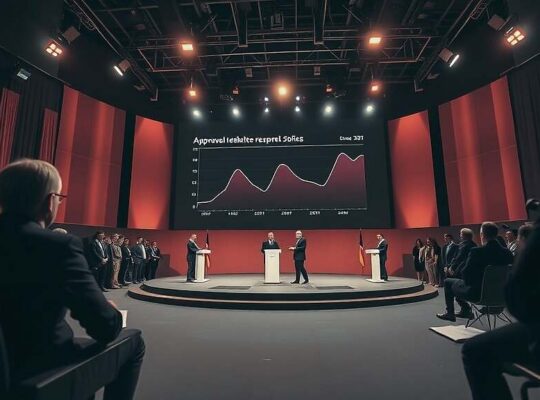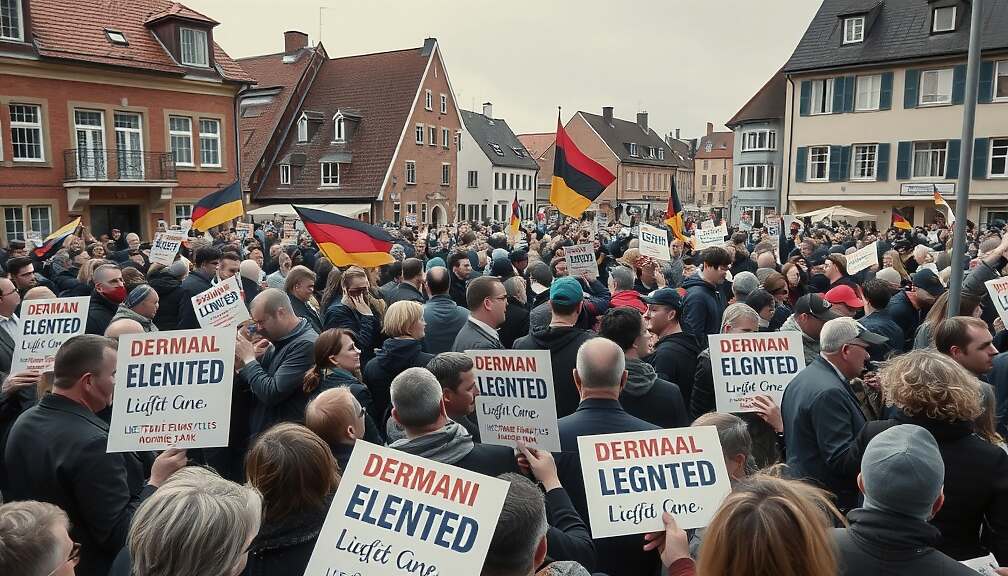
A challenging phase of government formation is reportedly approaching in Mecklenburg-Vorpommern as the state election is set for September 20th. A recent survey by the polling institute Forsa, commissioned by the “Ostsee-Zeitung,” indicates that the AfD, led by candidate Leif-Erik Holm, remains the strongest political force. However, similar to the Social Democrats (SPD) led by Minister-President Manuela Schwesig, the AfD will require coalition partners to govern.
Forsa conducted the survey among 1,047 eligible voters between August 21st and 27th, 2026. According to the results, the AfD is projected to maintain its standing at 37 percent. Meanwhile, the SPD, under Manuela Schwesig, shows an increase of five percentage points compared to its February poll and now stands at 28 percent.
The Linkspartei, led by Simone Oldenburg, is expected to become the third-strongest party in the new Schwerin state parliament, earning eleven percent. The Christian Democratic Union (CDU), headed by Daniel Peters, experiences a decline of three percentage points, falling to 10 percent. The Greens, represented by Claudia Müller, are projected to re-enter the state parliament with five percent (up from four percent in February). In contrast, the BSW (previously five percent in February) falls short of the five-percent threshold, achieving only four percent. The FDP is listed under “Other Parties” in the Forsa results.
Jan Müller, a politicalwissenschaftler at the University of Rostock and an expert on state elections, anticipates significant difficulties in forming a government. He notes that mathematically, an alliance between the AfD and the CDU could be possible, though this is a coalition the CDU has previously ruled out. Furthermore, a “Hamburg Coalition” involving the SPD, Linke, and CDU could secure a majority. However, Müller also points out that the CDU maintains a policy of incompatibility with the Linke. Given these constraints, Müller deems a minority government in Schwerin a viable option, drawing on the example of Saxony, which has been governed without a parliamentary majority since 2024. He stresses that in such scenarios, “clear agreements among all involved parties” are necessary.