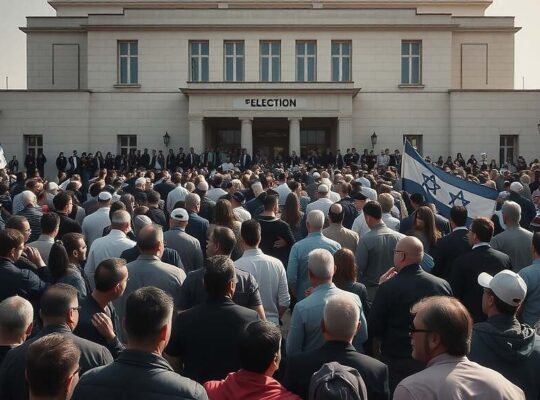
Following the Israeli parliamentary election, there is no clear victor. According to three separate post-election polls, neither the bloc centered around Prime Minister Benjamin Netanyahu nor the opposition coalition-comprising Social Democrats, Liberals, and Centrists led by former General Gadi Eizenkot-has achieved a majority of at least 61 seats in the Knesset.
Although Netanyahu’s Likud Party is projected to be the strongest single party with roughly 24 to 25 seats, his overall bloc is estimated to hold around 50 seats, while the opposition could reach 52 or 53 seats. The Arab parties, which together are expected to gain 17 to 18 seats according to the polls, might play a crucial role in the coalition negotiations; however, most opposition leaders have already ruled out cooperating with these groups.
The Central Election Committee reported that voter turnout reached its highest level since 1973. The efforts of Netanyahu’s bloc to secure a majority may be further complicated by the likely failure of smaller right-wing parties, such as Ofer Winters’ People of Israel and Yoaz Hendel’s Reservisten-Wirtschaftspartei, to cross the 3.25 percent threshold.
Furthermore, the prospect of a unified government between Netanyahu and Eizenkot appears unlikely, as Eizenkot has rejected collaborating with Netanyahu. Other opposition leaders have also excluded a coalition under the current Prime Minister’s leadership.