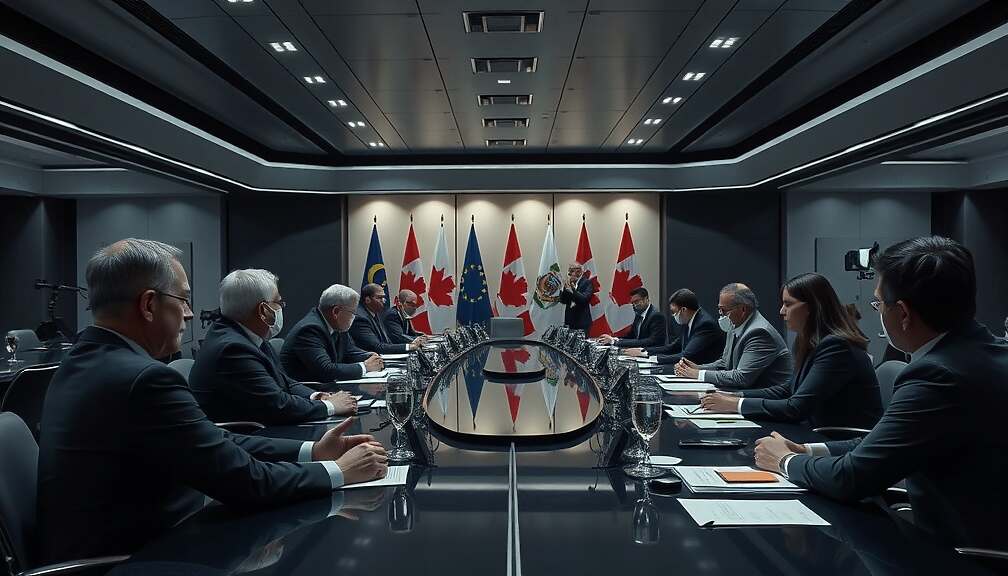
The European Union and Canada plan to elevate their relationship to a new level at an upcoming summit in Montreal on October 29th and 30th. Although EU Commission President Ursula von der Leyen mentioned the concept of Canadian “associated membership” recently, no mention of this status is present in official documents ahead of the EU-Canada Summit.
A key initiative planned for the meeting is the launch of what is described as an “Alliance for the Future,” a concept introduced by von der Leyen previously during a September address to the European Parliament, during which she also floated the idea of granting Canada a special status. This prior suggestion had provoked backlash from former US President Donald Trump, who labeled such a move a “hostile act” and threatened tariffs. Nevertheless, Canadian Prime Minister Mark Carney has repeatedly emphasized that his country does not seek full EU membership.
The agenda for Montreal will focus on deepening cooperation across several areas, including trade, digital policy, critical raw materials, defense, security, as well as education, research, and youth involvement. EU Council President António Costa announced that the aim is to further strengthen the political, economic, and institutional ties between the two parties.
The foundational partnership was established by two agreements signed in 2016: the Strategic Partnership Agreement (SPA) and the highly debated Comprehensive Economic and Trade Agreement (CETA). The SPA facilitates political dialogue and cooperation on international challenges, while CETA aims to simplify trade by reducing customs duties and barriers, improving conditions for businesses and investors. Under CETA, duties on 98 percent of tariff positions have been abolished, with all other remaining tariffs scheduled to be phased out gradually. This partnership has seen substantial financial growth; in 2025, trade in goods and services between the EU and Canada reached approximately 130 billion euros, representing an increase of over 80 percent compared to 2016.
Furthermore, in June 2025, the EU and Canada established a “Security Partnership” to deepen collaboration in areas such as crisis management, maritime security, cyber threats, and the defense industry. Canada is unique in that it is the only non-EU country outside of Europe participating in the EU’s defense instrument, “Safe.” This arrangement allows Canadian companies and products to participate in EU Member States’ joint procurement projects under specific conditions.