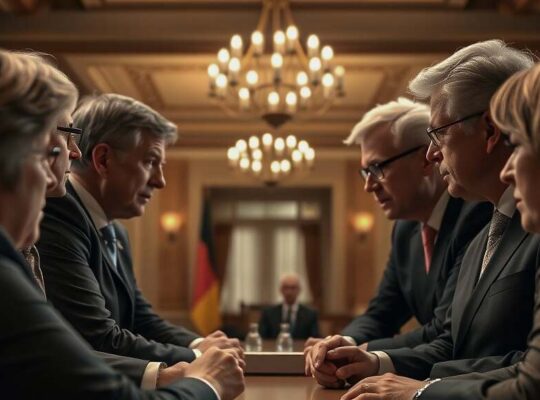
Jochen Flasbarth (SPD), the outgoing State Secretary at the Federal Environment Ministry, criticized the “reliance on fossil methods demonstrated by individual members of the government in the past.” Speaking to the “Tagesspiegel” (Thursday edition), he expressed regret that this hinders progress in climate protection, the economy, and the care of the land, though he did not name any specific individuals.
Flasbarth noted that achieving climate and nature conservation political goals is generally more difficult now than it used to be. He stated that the Union has become significantly more conservative and is no longer the “Merkel Union.” While he does not criticize this trend-acknowledging that highly conservative viewpoints find a place within the democratic spectrum-he argues this has led to the environment and economic ministries developing somewhat separately regarding climate and economic concerns.
Flasbarth is departing his role as State Secretary this Thursday after 13 years, predominantly within the Federal Environment Ministry. His next steps include taking the leadership of the European Climate Foundation in early 2027. He sees this move as a tremendous opportunity to collaborate with a foundation toward developing effective climate solutions for Europe.
He also noted seeing tangible progress within the current Federal Government. He defended the government’s approach, stating they did not tackle issues through blunt force because they kept public opinion in mind. He believes that, while progress is achieved step by step, the climate issue can be successfully brought out of political polarization, stressing that a clear future orientation is necessary for this to happen.
Regarding the recently agreed compromise between Germany and France to soften the timeline for phasing out internal combustion engines (ICEs), Flasbarth admitted he does not approve of the decision. Nevertheless, he remains confident in the future of the electric car, arguing that all future mobility must be electrical because EVs are technically far more efficient, and the energy required for their operation is considerably cheaper.