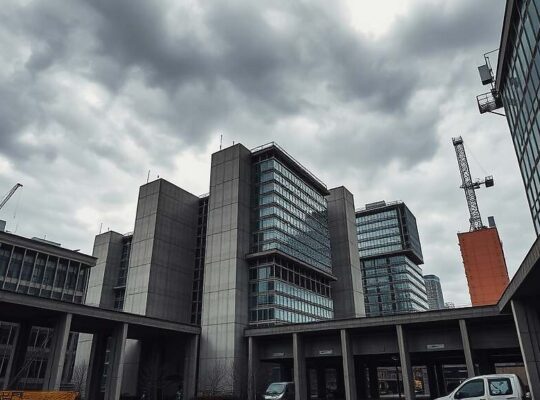
Alexander Eichholtz, the Chairman of the Charité Personnel Council, has issued a stark warning about the potential decline of Berlin’s central medical facility. Eichholtz pointed out to the Tagesspiegel that the hospital complex, which manages properties across half the city, includes numerous historically protected but dilapidated buildings. He stressed that the maintenance costs alone exceed the funding the hospital receives from the state, alongside various other rising expenses, threatening the entire medical healthcare system and its research capacity in Berlin.
Eichholtz, who previously worked as an intensive care nurse at various Charité departments before being elected to the staff representative body, has led the council since 2024. As Europe’s largest university hospital, Charité operates 3,300 beds and employs 25,000 people across its associated companies.
The crisis is exacerbated by budgetary decisions. In its emergency budget mode, the Senate has reduced university subsidies, potentially eliminating 10%-or 60 per year-of study places in human medicine. Eichholtz urged the new Senate, following the September election, to overturn these austerity measures, arguing that Berlin would struggle to attract enough medical graduates. Furthermore, he warned that cuts imposed by the federal government are increasing Charité’s already substantial deficit, which recently reached nearly 64 million euros.
He called on Berlin’s new government to immediately analyze which hospitals are absolutely necessary for the city’s functioning, and then, if required, to implement orderly closures of individual facilities. Eichholtz lamented that there is currently a “wild hospital death” (wildes Krankenhaussterben) unfolding, a situation that severely impedes care planning because it is often unclear where emergency services can be reliably deployed in the coming year.