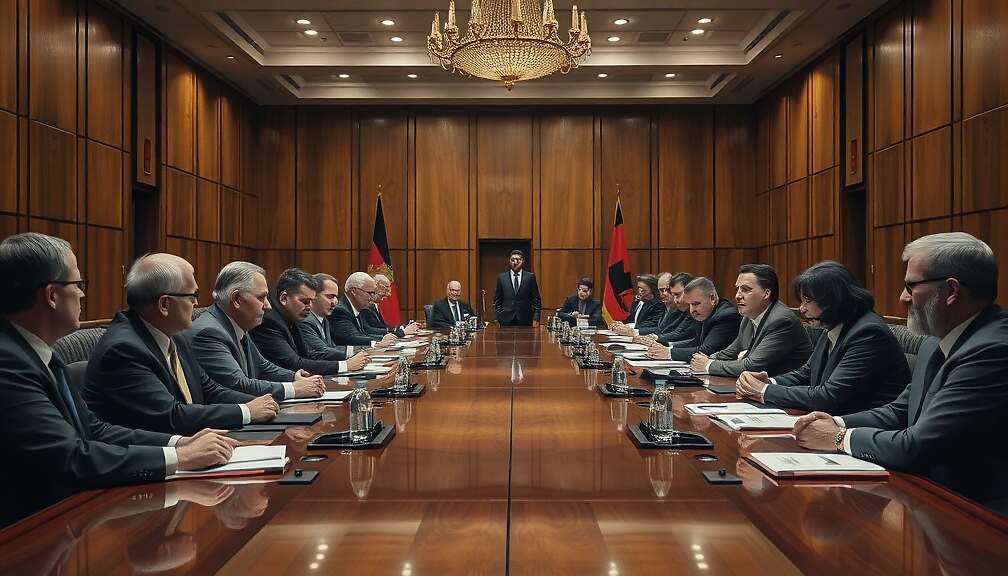
Internal documents reviewed by the Chancellor’s office before last Wednesday’s reform summit reveal that employers and unions began the discussions with fundamentally opposing viewpoints. As cited in the Sunday edition of the Handelsblatt, these pre-meeting papers highlight the deep disagreements on Germany’s economic and social policies.
Regarding Germany’s economic slowdown, the unions attribute the weakness primarily to three factors: high costs for energy and raw materials, insufficiently high public investment, and intense competition originating from China. In contrast, the employers argue that Germany is facing deeper structural shortcomings that exist regardless of external economic shocks. According to the 23-page report from the employers’ associations, the country has experienced a persistent decline in production and industrial employment over the past several years. They cite excessively high labor costs, weak private investment, high bureaucratic overhead, and a shortage of skilled workers as the main causes.
Disagreements also surfaced concerning specific reform proposals. The unions aim to strengthen workers’ rights, demanding a right to full-time employment, the elimination of arbitrary fixed-term contracts, and improvements to works council co-determination. The employers, however, are pushing for a reform of sickness benefits and a moderate adjustment to job protection laws.
Consensus is also absent in the field of pensions. The unions argue that increasing the retirement age is unproductive for boosting growth or employment rates. The employers’ associations advocate for the timely abolition of early retirement programs, linking the retirement age to increasing life expectancy, raising reductions for early retirement, and tightening the sustainability factor.
Tax policy likewise sees deeply divided stances. The DGB calls for higher taxation on high incomes, while the employers demand relief for partnerships in personal income tax by eliminating the solidarity surcharge (Soli).
After the meeting, participants maintained a low profile. On Thursday, Federal Chancellor Friedrich Merz (CDU) stated in the Bundestag: “This long discussion took place in an exceptionally good, very constructive atmosphere. We will continue to pursue certain topics individually.”