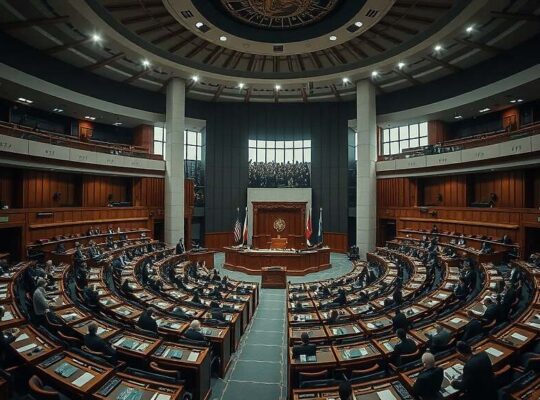
An assessment by the Bundestag’s Scientific Service has concluded that the Ministry of Defence acted illegally when it suspended parts of the compulsory military service law via an administrative regulation. This finding was reported by the ARD-Hauptstadtstudio, which based its report on an expert opinion commissioned by the Green parliamentary faction.
The core issue relates to a mandatory deregistration requirement for men aged between 18 and 45. Under the law, these individuals must receive approval from the relevant career center of the Bundeswehr if they intend to leave the country for longer than three months. This rule existed even before the suspension of mandatory service. Following the introduction of the so-called “New Military Service” at the beginning of the year, the rule has been reactivated, though this fact only drew public and political attention in early April.
Minister of Defence Boris Pistorius (SPD) quickly assured the public that the requirement would not apply unless a state of emergency occurred. Shortly thereafter, his ministry suspended it through a general administrative notice. However, the Scientific Service has serious doubts about the legality of this action. The report determines that by doing so, the Ministry of Defence significantly overstepped its authority within the Executive branch.
While the Ministry is legally permitted by the compulsory military service law to issue exceptions to the deregistration requirement, the expert report states that the general administrative notice entirely annulled a statutory provision. It clarifies that this power “is solely reserved for the Judiciary within the framework of constitutional review” meaning only the Federal Constitutional Court can invalidate laws or parts thereof.
For Desiree Becker, the Green faction’s deputy group leader, this development provides further evidence of “incompetence and ministerial maximal failure”. Becker had expressed her doubts about the procedure shortly after the ministry issued the general administrative notice, but these concerns were reportedly dismissed casually by Pistorius’s staff.
Indeed, Becker had pointed out potential legal errors to the federal government in a written inquiry on April 15. Just seven days later, she received a response from the Ministry of Defence that consisted of only three sentences, which failed to address her concerns.
The Scientific Service’s full opinion is much more detailed. Over 13 pages, the authors analyze the administrative notice and point out fundamental, technical flaws. For instance, they refer to the principle that if exceptions are defined within a law, there must still be cases remaining for which the law remains applicable. The opinion explains that “otherwise, the exception case becomes the rule” which is what happened.
However, the Ministry of Defence’s general administrative notice effectively exempts all men from the deregistration requirement. Consequently, there is no person left for whom the regulation still applies. Furthermore, because this exemption is made without any time limit, the ministry has created a “legal perpetual state” something the Executive branch is not empowered to do. Its mandate is simply to “apply and enforce laws”.
According to the report, the Ministry of Defence could revoke its own administrative notice. Alternatively, a court could declare it null and void.