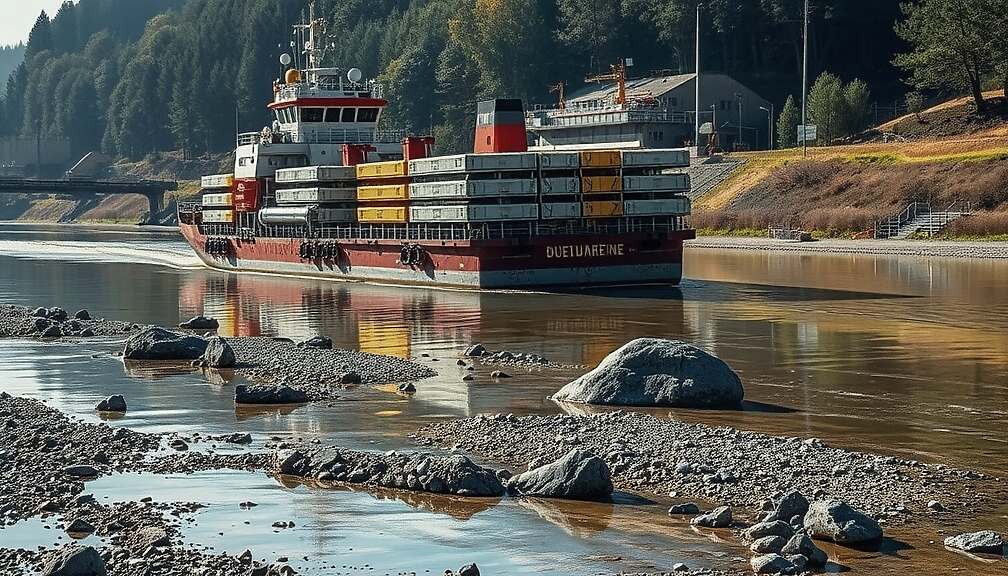
Tarek Al-Wazir, the Green Party politician focused on transport policy, believes that temporarily suspending the ban on Sunday travel is a sensible measure due to the low water levels plaguing German rivers. He stated to the news portal T-Online that in a situation of acute emergency, the federal government, states, ports, railways, and the economy must collectively ensure that critical supply chains remain operational.
Al-Wazir also demanded that possibilities for mobilizing additional rail capacity should be examined. He emphasized that particularly vital goods could be prioritized, and transport between ports, railways, freight forwarders, and companies needed to be closely coordinated.
However, the Green politician stressed that these efforts should only be short-term emergency measures. Looking ahead, he argued that the inland waterway transport must become permanently more resilient against low water. This requires the deployment of vessels suited for low water levels, a highly capable waterway administration, and prompt actions taken on the affected river routes.
Furthermore, Al-Wazir warned that climate change increases the risk of such extreme situations. He concluded that short-term crisis intervention, long-term prevention, and consistent climate protection must be integrated into a unified strategy.
Amid the ongoing low water crisis, Federal Transport Minister Steffen Bilger (CDU) is considering a temporary lifting of the Sunday driving ban for trucks as an emergency measure. Bilger noted to “Bild” on Thursday that this possibility remains on the table. He elaborated that if traffic on the Rhine waterway were to completely grind to a standstill, they would need to look at diverting transport onto roads or onto rail.