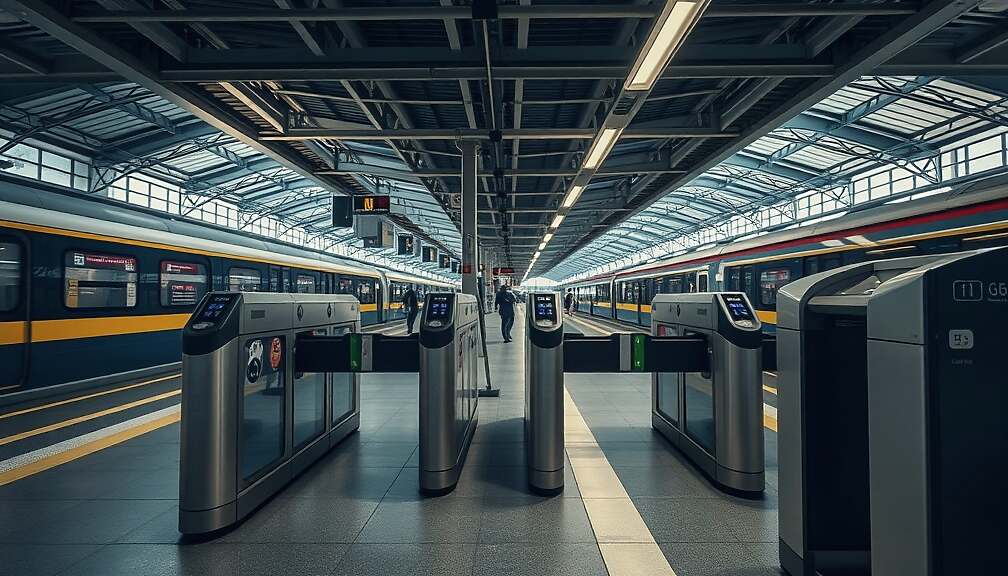
The proposal by Federal Transport Minister Steffen Bilger to examine the introduction of ticketing barriers at large German railway stations has faced criticism from various political factions. Tarek Al-Wazir of the Green Party, who chairs the Bundestag’s Transport Committee, dismissed the idea of implementing platform access control as impractical. While acknowledging that Minister Bilger’s initiative stems from a recognized need for greater security, Al-Wazir highlighted that certain regional and long-distance services in Germany run on the same tracks with minimal frequency differences, making such access requirements impossible for regional travel.
Al-Wazir further argued that a technical implementation of platform control is fundamentally unsuited to the complexities of the rail system. He noted that every station operates differently, requiring individualized and extremely costly solutions. Furthermore, he warned that implementing platform access controls across the board would likely lead to the collapse of the entire system under the pressure of daily commuter flows.
The AfD faction, represented by spokesperson Wolfgang Wiehle, views the measures as potentially viable but cautions against immediate implementation. He pointed out that the existing structure of German railways-such as through stations with multiple access points or the simultaneous use of tracks by regional and long-distance trains-presents significant obstacles. Wiehle suggested that Deutsche Bahn’s infrastructure division (DB Infrago) and DB Fernverkehr should first conduct a pilot project involving access controls at major hubs like Frankfurt, Munich, or Leipzig. Critically, he insisted that this initial trial must be limited to platforms used exclusively by long-distance services, and that the test phase must remain open-ended before any major decisions are made.
In contrast, the SPD, Bilger’s coalition partner, supports the Minister’s approach. Martin Kröber, the SPD Parliamentary Group’s transport reporter, called linking platform access to a valid ticket a “practical and efficient step” toward enhancing railway safety. Kröber urged that such a system be implemented quickly and comprehensively across the entire network, rather than relying on protracted testing periods at isolated locations. This sentiment aligns with Minister Bilger’s own statements to the Funke Media Group, where he indicated that increasing the link between valid tickets and platform access could be beneficial, particularly for long-distance travel.