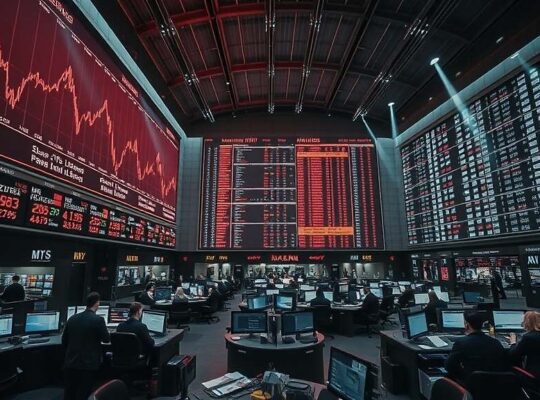
The Dax showed only minimal movement on Tuesday. By the end of trading on Xetra, the index stood at 26,007 points, marking a gain of just one point compared to the previous day’s close. Among the stocks attracting attention were shares in Fresenius, Rheinmetall, and Volkswagen, while Infineon, Hannover Rück, and Heidelberg Materials settled at the lower end of the price list.
Andreas Lipkow, Chief Market Analyst at CMC Markets, noted that the effort to push the Dax above the 26,000-point mark is becoming increasingly difficult. He stated that investor focus remains highly fixed on oil prices, with the $100 threshold acting as a crucial pivot point for investment decisions. “Quotations below that level trigger sporadic purchases in the stock market, while prices above it almost completely spoil investors’ appetite for risk assets.”
According to Lipkow, rising energy costs and their consequent overheads are simultaneously suppressing consumer sentiment and prompting central banks to raise key interest rates. “Neither of these is a compelling argument for stocks-and precisely because high bond yields offer a genuine alternative investment, they are competing directly with stock prices. Many asset managers are already considering reallocations, leading to capital outflows from equity markets.”
He further commented that the current geopolitical environment, characterized by increased energy costs and supply chain disruptions, is preventing a continuation of the economic recovery in Europe and specifically in Germany. He stressed that Germany’s high reliance on raw materials means companies are struggling with falling margins, which are unlikely to be covered by further layoffs or cost-cutting measures in the mid-term.
In unrelated markets, the European common currency showed slight strength on Tuesday afternoon; the Euro traded at $1.1628 per US Dollar, meaning the Dollar was valued at 0.8600 Euros. The price of gold saw a slight decline, falling 0.1 percent to $4,401 per troy ounce in the afternoon, equivalent to 121.67 Euros per gram. Meanwhile, oil prices increased: a barrel of Brent crude in the North Sea cost around $97.88 late Tuesday afternoon, an increase of 88 cents, or 0.9 percent, compared to the close of the trading day prior.