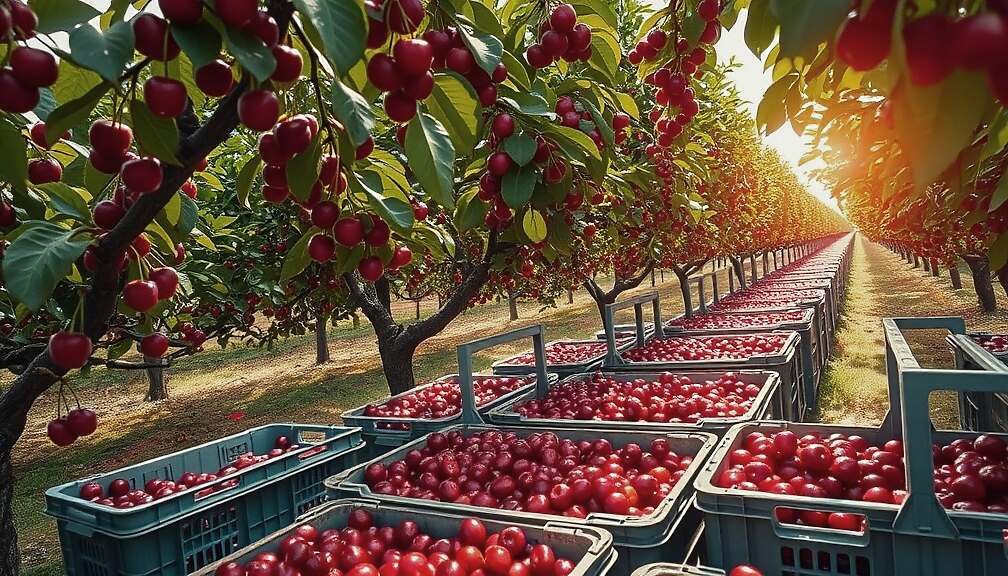
According to final estimates released by the Federal Statistical Office (Destatis) on Monday, German fruit farming achieved a strong cherry harvest in the summer of 2026, totaling approximately 48,500 tonnes of sweet and sour cherries. This 2026 yield was 7.8 percent above the average of the last decade (2016-2025) and exceeded the previous year’s harvest by 3.0 percent. Of the total volume, sweet cherries accounted for 80.2 percent (38,900 tonnes), while sour cherries represented 19.8 percent (9,600 tonnes).
The success in the sweet cherry sector was driven by the 38,900-tonne harvest, which was 16.2 percent higher-or 5,400 tonnes more-than the ten-year average of 33,500 tonnes. Based on a cultivation area of 5,600 hectares, this yields an average sweet cherry production of 6.9 tonnes per hectare.
However, sweet cherry production varied regionally. Baden-Württemberg, the most important state for sweet cherry cultivation with 2,600 hectares, recorded 19,100 tonnes, which is 16.7 percent above the ten-year average. In contrast, Rheinland-Pfalz, the second-largest growing region with 660 hectares, saw its yield drop by 37.2 percent compared to the average. Notably, Lower Saxony, the third-largest region, experienced exceptional productivity, harvesting 6,700 tonnes of sweet cherries on just 500 hectares-a massive increase of 66.0 percent over the decade’s average.
Sour cherry cultivation remains a smaller enterprise. While sweet cherries are grown on about 5,600 hectares across Germany, sour cherries occupy approximately 1,500 hectares. Over the last decade, the area dedicated to sour cherries has decreased by a quarter, falling from 2,000 to 1,500 hectares (-25.8 percent). The final estimate for the 2026 sour cherry harvest stands at 9,600 tonnes, 16.8 percent below the ten-year average. The yield for sour cherries is 6.4 tonnes per hectare, slightly under the overall decade average (-1.1 percent). The largest sour cherry grower is Rheinland-Pfalz (460 hectares), followed by Saxony (300 hectares) and Baden-Württemberg (240 hectares). Regional differences are also evident in this sector: Baden-Württemberg achieved the highest volume with 2,800 tonnes (+38.1% over the average), followed by Rheinland-Pfalz at 2,100 tonnes (-46.1%), and Thuringia at 1,500 tonnes (-7.1%).
Looking ahead, fruit producers also anticipate a good pear harvest in 2026, with preliminary estimates showing a total yield of around 40,900 tonnes. Statisticians project this volume will be 7.7 percent higher than the ten-year average, though it is expected to be 3.3 percent lower than the vigorous previous year. The anticipated average yield across the 2,100 hectares of pear cultivation is 19.8 tonnes per hectare.
This optimistic forecast is supported by strong yield expectations in Baden-Württemberg, the leading region for pear cultivation. Here, 18,600 tonnes are expected from 860 hectares, accounting for 45.4 percent of Germany’s total pear production. Based on initial figures, the Baden-Württemberg yield is projected to be 28.1 percent above the ten-year average and 7.9 percent above the previous year. Bayern is the second largest pear-producing region (270 hectares), with an expected yield of 2,700 tonnes, representing a deficit of 45.8 percent compared to the ten-year average. Lower Saxony holds the third position in cultivation area (260 hectares), where a pear harvest of 7,100 tonnes is anticipated, surpassing the decade average by 14.0 percent.