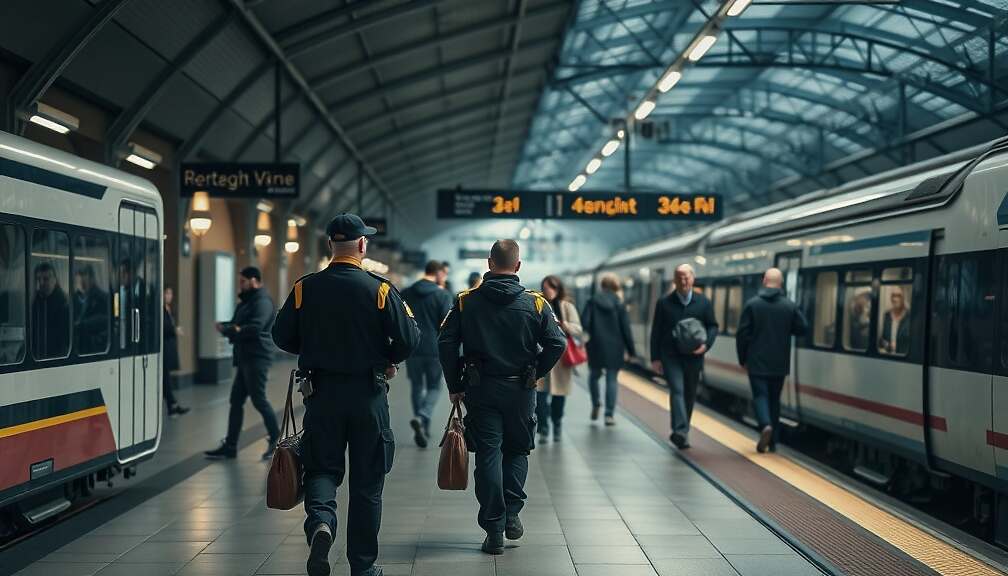
Following the announcement by Deutsche Bahn CEO Evelyn Palla that an alcohol ban will be introduced in all German train stations starting mid-October, both the Union and the SPD have demanded that the railway company provide the necessary staffing increases.
Alexander Throm, the Union’s spokesman for domestic policy, welcomed the Deutsche Bahn’s enhanced security efforts, stating in the “Welt” (Wednesday edition) that the company should, however, enforce these new rules using its own staff. The SPD also placed responsibility on the railway, noting that the ban could only be considered if DB Security could demonstrate a substantial increase in personnel, according to SPD faction spokesman Sebastian Fiedler.
The AfD parliamentary group deemed the railway’s proposal feasible, arguing in the “Welt” that the existing cigarette ban, which is largely enforced in many areas, could be expanded. Wolfgang Wiehle, the AfD’s spokesman for transport policy, suggested that further, well-thought-out alcohol bans in trains could follow, particularly in regional services commissioned by the various states.
Conversely, The Left criticized the initiative, arguing that an alcohol ban would not solve the core problems. Luke Hoß, the policy spokesman for The Left, accused the CEO of shirking responsibility while placing greater control burdens on employees. He added, “We are all paying the price now because Deutsche Bahn neglected maintenance at their stations after privatization.”
Heiko Teggatz, the federal chairman of the German Police Union, urged the railway to deploy staff to monitor the alcohol ban. He stated, “This is an internal matter for the railway. They must ensure they have enough security personnel.” He clarified that police involvement would only be necessary if passengers refused to leave a station, but stressed that the police themselves require reinforcement, noting that they currently face a deficit of around 3,500 officers in station areas. Despite these calls for reinforcement, Teggatz expressed general approval for the ban, arguing that “alcohol and drugs lower inhibitions and frequently lead to acts of violence.”
Andreas Roßkopf, federal chairman of the policing union for the Federal Police, said that monitoring the alcohol ban is fundamentally achievable with the police’s existing resources, and he welcomed the ban. Roßkopf alleged that “train stations are now criminal hotspots,” citing that there were nearly 28,000 violent crimes in station areas last year alone. He contended that a ban on alcohol could act as a deterrent. He noted that such bans are already in place in cities like Munich, Frankfurt, and Hamburg, where he claimed they resulted in a reduction in criminal and violent acts.