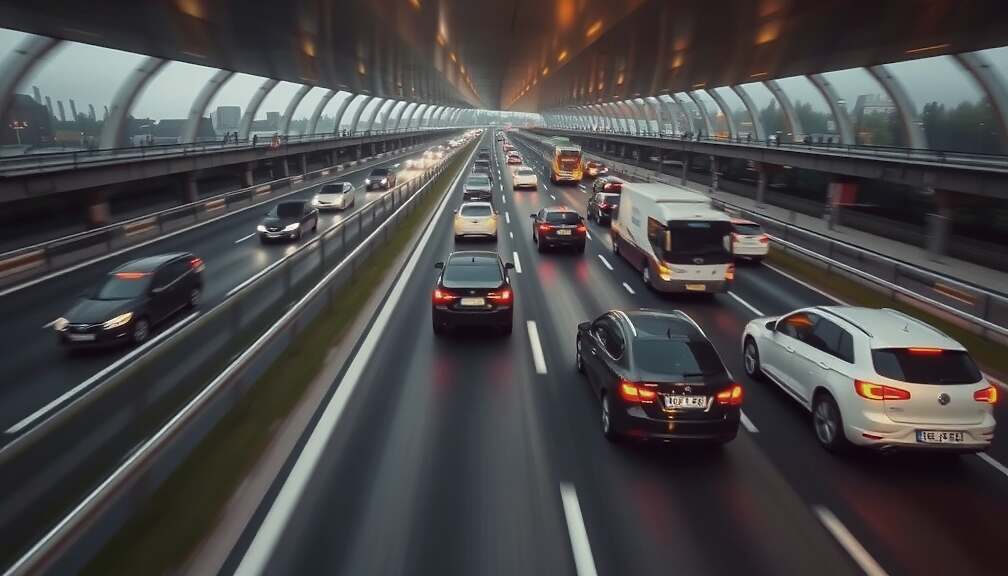
The new Federal Transport Minister, Steffen Bilger (CDU), has rejected the idea of implementing a general speed limit on German Autobahns, stating that such a measure is unlikely to be introduced during the current legislative period of the Union and SPD. Speaking to the RTL and ntv program “Frühstart” on Thursday, Bilger confirmed his personal disapproval of speed restrictions. He emphasized that Germany already boasts some of the safest highways and reports fewer traffic fatalities than many countries in Europe that utilize speed limits.
The CDU politician explained that his priorities remain safety and the smooth flow of traffic. He noted that telematics systems, which adjust speed according to weather and traffic conditions, are already in use on numerous highway sections.
Statistics from the Federal Statistical Office (Destatis) indicate that in 2022, Germany recorded 23.9 deaths per 1,000 kilometers of highway. While this figure places Germany in the middle range among the 18 European countries reviewed, it is notable that Germany is the only country without a general speed limit to register this level of fatalities. For comparison, Belgium had 48.8 deaths per 1,000 km, while Sweden reported only 2.7.
Conversely, research suggests that introducing a speed limit could significantly reduce traffic fatalities. Calculations from Ruhr University Bochum predict that if a general speed limit of 120 km/h were implemented on German Autobahns, the number of traffic deaths could drop by 35 percent. Furthermore, the Federal Environment Agency has estimated that speed limits could save a total of 6.6 million tons of CO2 equivalents and roughly 2.8 billion liters of fuel.